


What Makes a Good DID Number Provider?
Choosing a virtual phone number provider is about long-term reliability, flexibility, and how well the service integrates with your communication infrastructure.
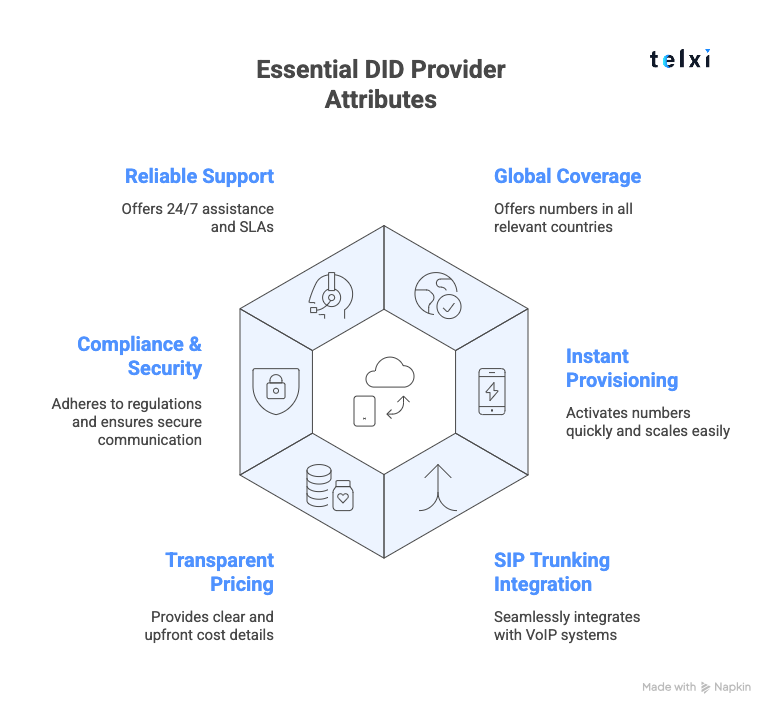
Here’s what you should look for when evaluating DID providers:
-
Global Coverage:
Can the provider offer local, national, mobile, and toll-free numbers in the countries where you do business? -
Instant Provisioning & Scalability:
The ability to activate numbers instantly and scale up or down without delays or friction. -
SIP Trunking Integration:
For businesses using VoIP, seamless SIP support ensures inbound calls route properly and securely. -
Transparent Pricing:
Look for providers that list costs clearly — including per-number charges, channel fees, and usage rates — without surprise add-ons. -
Compliance & Security:
Ensure the provider follows local regulations, supports number portability, and offers encryption like TLS/SRTP for secure voice transport. -
Reliable Support:
24/7 support and service level agreements (SLAs) are critical for enterprise and mission-critical environments.
Best DID Number Providers for Businesses in 2026
Choosing between the best DID number providers isn’t just about having access to numbers — it’s about getting the right coverage, integration, and control. Below, we break down the top providers in the market, highlighting what they do best, where they fall short, and who they’re best suited for.
Telxi

Telxi is a global virtual number provider built for scale, transparency, and performance. It offers instant access to DID numbers in 50+ countries, with seamless integration into SIP trunks, PBX systems, and global voice platforms. Whether you’re a startup or an international enterprise, Telxi delivers carrier-grade quality with enterprise-ready reliability.
Telxi’s infrastructure is optimized for fast provisioning, local compliance, and high call concurrency. Their DID platform supports voice, fax, SMS (in select countries), and intelligent routing — all manageable through a unified dashboard. With no contracts, minimums, or hidden fees, Telxi simplifies global number management.
Pricing:
Telxi uses a pay-as-you-go pricing model. DID numbers start at $1/month, with usage-based charges depending on destination and channel volume. Number setup is instant, and porting existing numbers is fully supported. Full pricing is available on Telxi’s website.
Standout Features:
DID numbers in 50+ countries (local, national, mobile, toll-free)
Native SIP trunking integration
On-demand provisioning & porting
TLS/SRTP encryption and fraud protection
Supports fax & SMS in supported regions
Real-time usage analytics and alerts
Pros & Cons:
| Pros | Cons |
|---|---|
| Transparent pricing with no long-term contracts | Limited support for bundled UCaaS tools |
| Instant number provisioning & SIP setup | Some advanced routing features require setup guidance |
| 120+ countries with full compliance | |
| 24/7 support and SLAs available | |
| Multi-tenant support for resellers and partners |
Best For:
Global businesses, enterprise contact centers, and SaaS platforms that need secure, scalable inbound calling with full control and instant setup.
Integrations:
Compatible with FreePBX, 3CX, Microsoft Teams, Zoiper, and Cisco. Check all integrations here.

Twilio

Twilio is a developer-centric platform offering voice APIs, messaging, and virtual phone numbers with global reach. While Twilio is not a traditional DID provider, it gives businesses programmatic access to virtual numbers in 100+ countries, with strong documentation and flexible usage.
Twilio is ideal for companies building custom communication workflows, especially SaaS tools or platforms needing embedded voice and messaging features. However, it requires technical expertise, and its pricing can be opaque depending on usage volume and country.
Pricing:
Twilio’s pricing is usage-based and varies significantly by number type and country. Local numbers start around $1–$2/month, but additional fees apply for voice usage, inbound minutes, and call forwarding. Porting and provisioning are handled via API or console.
Standout Features:
-
Numbers in 100+ countries via API
-
Extensive developer tools and SDKs
-
Voice, SMS, and call control via TwiML
-
SIP Domain registration for VoIP routing
-
Elastic scalability with custom usage controls
Pros & Cons:
| Pros | Cons |
|---|---|
| Powerful APIs and developer flexibility | Requires technical implementation |
| Global DID access for programmable voice | Pricing can become complex for scale |
| Integrates with SIP trunks and PBXs | No SLA or 24/7 support by default |
Best For:
Tech-savvy startups, CPaaS applications, and SaaS platforms embedding voice and messaging.
Integrations:
Native support for SIP, WebRTC, TwiML, and tools like AWS Lambda, CRMs, and analytics stacks.
Avoxi

Avoxi is a virtual number provider focused on enterprise-grade voice solutions. It offers DID numbers in over 60 countries, with a user-friendly interface and strong emphasis on compliance, global call routing, and centralized management. Unlike developer-first platforms, Avoxi provides a plug-and-play experience for larger teams and contact centers.
Its standout feature is the Avoxi Genius platform, which includes intelligent call routing, call recording, real-time analytics, and cloud PBX functionality — making it a complete inbound voice solution.
Pricing:
Avoxi is transparent about pricing for most countries. Local numbers typically start at $4–$7/month, with included minutes and additional per-minute charges based on region. Bulk discounts and enterprise quotes are available.
Standout Features:
-
DID coverage in 60+ countries
-
Cloud PBX and intelligent routing tools
-
Compliance-ready infrastructure
-
Built-in call recording and analytics
-
Local number porting and bulk provisioning
Pros & Cons:
| Pros | Cons |
|---|---|
| Intuitive platform for non-developers | Some features are locked behind higher plans |
| Good global reach and voice reliability | Higher starting price than competitors |
| Built-in routing and analytics tools | Limited developer-focused tools |
Best For:
Enterprise call centers, customer support teams, and multinational companies needing an all-in-one inbound call management solution.
Integrations:
Supports integrations with CRMs like Salesforce, HubSpot, and cloud PBX systems.
Vonage

Vonage offers virtual phone numbers and cloud communications tailored for small to midsize businesses (SMBs). It provides DID numbers in around 40 countries, bundled within its unified communications (UCaaS) and contact center solutions. While Vonage is strong in voice quality and ease of use, it’s more limited in terms of international number coverage and pricing transparency.
Vonage is ideal for businesses that want an all-in-one phone, messaging, and collaboration suite, especially if they don’t require deep customization or global voice infrastructure.
Pricing:
Vonage does not publicly list specific pricing for DIDs. Pricing is typically bundled into business plans, with monthly per-user fees starting around $20–$30/month. DID number availability and costs may vary by region and use case.
Standout Features:
-
UCaaS platform with calling, video, and messaging
-
DIDs in 40+ countries (mostly metro areas)
-
CRM integrations and desktop/mobile apps
-
Simple setup and provisioning for SMBs
-
Optional add-ons like call recording and auto-attendants
Pros & Cons:
| Pros | Cons |
|---|---|
| Easy to use, bundled communication tools | Limited DID availability in some countries |
| Good call quality and app experience | No standalone DID service without full plan |
| Solid CRM and business app integrations | Lack of pricing transparency |
Best For:
SMBs and startups seeking a full UCaaS experience with light international number needs.
Integrations:
Works with Salesforce, Microsoft 365, Google Workspace, and popular helpdesk tools.
Sonetel

Sonetel is a low-cost virtual number provider targeting freelancers, small businesses, and entrepreneurs. It offers DID numbers in 50+ countries and emphasizes affordability, basic call forwarding, and voicemail functionality. It’s best suited for users who want to appear local without needing enterprise-level infrastructure or deep integration capabilities.
Sonetel operates primarily through its website, with a self-service platform. It lacks some of the advanced routing or analytics features of larger providers but excels at offering a simple, cost-effective way to get started with global phone numbers.
Pricing:
Sonetel offers some of the lowest prices in the market, with local DIDs starting from $1–$2/month. Forwarding costs vary by destination and usage. A free trial is available, but advanced features like call recording or team routing come at an additional cost.
Standout Features:
-
DIDs in 50+ countries
-
Low monthly costs and entry point
-
Basic routing and voicemail options
-
Focus on solopreneurs and small businesses
-
Email-based support with automation
Pros & Cons:
| Pros | Cons |
|---|---|
| Very affordable and beginner-friendly | No 24/7 live support |
| Quick signup and number provisioning | Limited features for scaling teams |
| Local presence in key countries | Minimal integrations and limited analytics |
Best For:
Freelancers, solo founders, and small teams looking for budget-friendly global numbers without complex routing needs.
Integrations:
Minimal; mainly operates standalone or through manual SIP forwarding.
How to Choose the Right Virtual Phone Number Provider?

Choosing the best DID number providers comes down to aligning their strengths with your specific business needs. Here’s a practical approach to help you decide:
Define Your Coverage Needs
Start by identifying the countries where you need virtual numbers. If you’re supporting global customers or expanding into new markets, prioritize providers with wide international coverage.Evaluate SIP Trunking Compatibility
Ensure the provider integrates easily with your existing PBX or VoIP infrastructure. Native SIP support or compatibility with your SIP trunk provider is critical for routing efficiency.Check for Transparent Pricing
Avoid providers that obscure costs or require custom quotes for basic services. Look for a clear breakdown of monthly number fees, call rates, and forwarding charges.Understand Provisioning and Porting Options
Instant provisioning can speed up deployment dramatically. Also, verify that the provider supports porting your existing numbers if you’re switching services.Assess Customer Support and SLAs
Global businesses need 24/7 support, especially if you’re serving customers across time zones. Check for uptime guarantees, live chat, or dedicated support teams.Compliance and Data Security
For industries with strict regulations, ensure your provider supports E911, GDPR, or local telecom compliance where required.


