
In this guide, we’ll break down everything businesses need to know about international calling rates: what affects pricing, how SIP trunking and VoIP can reduce costs, pricing models to consider, and how to choose the right provider to ensure high-quality, affordable global communication.
Whether you’re a sales team reaching out to prospects in new markets, a customer support team helping international clients, or a growing business expanding across regions, international calling is often a critical part of your operations.
Jump To
TL;DR — What to Know About International Calling Rates
Rates vary by destination, call type, and provider. Mobile calls and premium destinations often cost more than landline calls.
SIP trunking and VoIP reduce costs by routing calls over the internet rather than traditional telecom networks.
Per-minute vs. bundled pricing models affect how much you pay — especially if your team makes frequent international calls.
Call quality matters. Cheaper rates may come with poor routing or low-quality audio. Prioritize providers with premium termination.
Telxi offers transparent, competitive international rates, with global reach, real-time analytics, and crystal-clear call quality for sales, support, and enterprise teams.
International Calling Rates Main Questions
- What’s the cheapest way to make international calls for business?
Using a VoIP or SIP trunking service is usually the most cost-effective option. These services route calls over the internet instead of traditional phone lines, significantly reducing costs — especially for high-volume or recurring calls.
- How do international call rates work?
International call rates are typically calculated per minute and vary depending on the destination country, whether the number is a landline or mobile, and your provider’s routing quality. SIP trunking and VoIP platforms often offer more competitive rates than traditional telecom carriers by routing calls over the internet.
Why Do International Calling Rates Matter for Business?
If in your business you’re closing deals, supporting customers, or managing distributed teams, international calling is a must. It’s a critical part of how your team communicates and delivers value. Without a clear understanding of how international rates work, you could be overspending or sacrificing quality.
For example, in a sales teams, every extra cent per minute adds up when making hundreds of outbound calls to prospects in different countries. Or for support teams, poor call quality can damage directly customer satisfaction.
International rates also affect:
Cost predictability: You need reliable pricing to plan budgets across departments.
Vendor relationships: Lack of transparency or unfair rates from your provider can hurt trust and make negotiations harder.
Scalability: As your team expands into new countries or hires remote workers, you need a communication solution that can grow with you.
Customer experience: Delays, drops, or poor audio in international calls can negatively impact your brand perception in key markets.
What Affects International Calling Rates?
The most important variables that affect international calling rates include call destination, call type, routing quality, origin-based pricing, and volume discounts. Here is a breakdown of each one:
Call Destination & Region Tiers
The country or region you’re calling is the biggest driver of per-minute costs. Most carriers group destinations into pricing tiers based on demand, infrastructure, and interconnection agreements.
For example:
USA & Western Europe often fall into Tier 1: highly connected and cost-efficient, with rates as low as $0.005–$0.03 per minute.
Asia & Latin America typically fall into mid-tier pricing, with more variability depending on the country.
Africa and parts of the Middle East are often Tier 3, with the highest costs due to limited routing options and higher termination charges.
If your business regularly calls certain countries, reviewing their tier classification helps anticipate costs and choose the right plan.
Call Type: Landline, Mobile, Toll-Free
Rates differ significantly based on whether the number dialed is a landline, mobile, or toll-free:
Landline numbers are generally the most affordable because they’re fixed and don’t incur mobile network surcharges.
Mobile calls tend to cost more due to termination fees charged by mobile carriers.
Toll-free numbers may not be free internationally. In some regions, calling a toll-free number from abroad is treated as a premium call, with rates set by the destination carrier.
Being aware of these differences helps businesses control costs and choose the most efficient way to reach customers.
Routing Quality: Standard vs. Premium
The quality of the route (meaning how your call travels from point A to point B) can affect both the price and the call experience.
Standard routing (sometimes called least-cost routing or LCR) prioritizes the cheapest available path. It may go through multiple intermediate networks, increasing the number of “hops” and the chance of degraded audio, delays, or dropped calls.
Premium routing uses direct interconnects with Tier-1 carriers, ensuring low latency, high audio fidelity, and reliable connections, vital for customer-facing teams or high-value conversations.
Paying slightly more for premium voice termination can make a significant difference in how your business is perceived on international calls.
Origination Rules & OBR (Origin-Based Rates)
Some countries apply Origin-Based Rating (OBR), meaning the cost of the call depends not just on where it’s going, but where it starts.
For example, a call to a European country from the U.S. might cost $0.015/min, but the same call from the Middle East or South America could be priced higher due to surcharges or regulatory fees imposed by the destination provider based on the call’s origin.
This can complicate rate sheets and make it harder to predict total costs.
Volume & Commitments
For international calling rates, the more you call, the more leverage you have. Providers often offer pricing tiers based on monthly call volume, number of concurrent channels, and commitment level.
If your business makes regular international calls, choosing a bundled minutes package or negotiating volume-based pricing can cut your per-minute rate significantly.
On the flip side, some businesses benefit more from pay-as-you-go pricing if their international usage is low or unpredictable. The key is to align your pricing model with real-world calling patterns, and work with a provider that doesn’t lock you into expensive, underutilized plans.
What Pricing Models Are Used for International Calling?
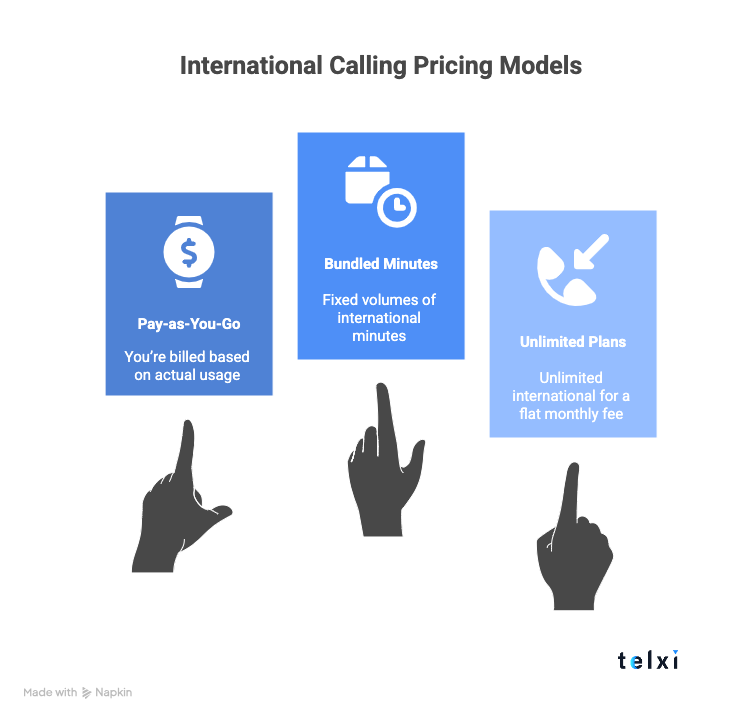
The pricing model your provider uses will directly impact how much you pay each month and how predictable those costs are. The 3 most common pricing structures are pay-as-you-go, bundled and unlimited or flat-rates plans. Here is the breakdown:
1. Pay-as-You-Go (Per-Minute Pricing)
This is the most flexible model when it comes to international calling rates. You’re billed based on actual usage, usually by the minute, with rates that vary by country and call type (landline, mobile, premium). Ideal for businesses with low or unpredictable international call volumes, this model avoids overcommitment but may lead to fluctuating monthly bills.
Best for small teams, low-call-volume businesses, early-stage startups, or seasonal operations.
2. Bundled Minutes Packages
Providers offer fixed volumes of international minutes (e.g., 1,000 minutes/month) to specific countries or regions. If you exceed the cap, additional minutes are charged at standard rates. Bundles can offer volume discounts and better predictability.
Best for sales/support teams with consistent international call volume or businesses targeting specific countries.
3. Unlimited or Flat-Rate Plans
Unlimited plans allow unlimited international calling to a set list of countries for a flat monthly fee. While this offers the highest predictability, most of these plans include a fair usage policy, so they’re not truly unlimited. Also, they may not include mobile or premium numbers.
Best for businesses with heavy, predictable call traffic to supported countries, especially support centers and outbound sales teams.
What Do International Calling Rates Look Like by Region?
International calling rates vary significantly depending on the region, destination type (landline or mobile), and your provider’s routing quality. Here’s a sample breakdown of typical per-minute ranges businesses might encounter:
| Region | Landline (per min) | Mobile (per min) | Notes |
|---|---|---|---|
| USA & Canada | $0.005 – $0.015 | $0.01 – $0.02 | Low-cost, high-quality |
| Western Europe | $0.01 – $0.03 | $0.02 – $0.05 | Varies by country |
| Asia | $0.02 – $0.06 | $0.03 – $0.09 | Often higher for mobile destinations |
| Africa | $0.10 – $0.30 | $0.15 – $0.50 | Highest rates, quality varies |
📌 Note: These are average market ranges of international calling rates. Actual rates depend on your provider, destination prefix, call volume, and the routing tier (standard vs premium). Always confirm current pricing with your provider.
How to Reduce International Calling Costs?
The best way to reduce international calling costs is by adopting SIP trunking combined with enterprise-grade voice termination. You should also consider factors like route quality, codecs, and call path optimization, and avoid low-cost routing traps that often degrade call performance. Below, we break down the key strategies that help businesses save money while ensuring every international call is reliable and clear.
Use Tier-1 Routes and Premium Carriers
Not all international routes are created equal. Some providers use low-cost routing that relies on intermediate carriers and longer hops, which often leads to degraded voice quality, latency, and call failures.
Tier-1 carriers, by contrast, connect directly to destination networks without relying on intermediaries. This minimizes delay, jitter, and packet loss — delivering clearer, faster, and more stable calls. Although Tier-1 routes may cost slightly more per minute, the overall business value is higher: fewer dropped calls, more productive conversations, and better customer impressions.
Businesses with customer-facing teams — like sales, support, or account management — benefit the most from Tier-1 or premium routing, where audio clarity and uptime are non-negotiable.
Adopt SIP Trunking for Cost Efficiency
Traditional phone systems often force you to overpay for fixed lines or bundles you don’t fully use. SIP trunking changes the game by letting you scale voice capacity with your actual call volume — paying for concurrent call capacity, not for idle lines.
With SIP trunks, you can:
Combine local and international voice under one platform.
Add or remove channels on demand.
Choose between metered (per-minute), flat-rate, or hybrid billing.
This makes SIP ideal for growing teams or businesses with global footprints. For example, a remote sales team making calls to different time zones won’t require constant maximum capacity — so SIP allows them to scale up or down without financial waste.
Optimize Call Paths and Codecs
The route your calls take impacts both quality and bandwidth efficiency. Codecs are the algorithms that compress and decompress voice data. Common options include:
G.711: High-quality, uncompressed audio with higher bandwidth usage.
G.729: Compressed audio that uses less bandwidth but with slightly lower quality.
For most international business calls, G.711 is preferred when bandwidth allows, especially for customer-facing roles where clarity is key. G.729 or similar low-bandwidth codecs may be suitable for internal calls or when network constraints exist.
Avoid Overpaying for Low-Quality Routes
While cutting costs is important, some providers offer ultra-cheap international rates by using least-cost routing (LCR). These routes often pass through multiple carriers or grey routes, unofficial or semi-regulated paths that can lead to:
Echoes, dropped calls, or delayed audio
Blacklisting or blocking in certain regions
Compliance and regulatory risks
In high-volume scenarios, this may save a few cents per call, but at the cost of poor user experience and reduced reliability. If your team is regularly dealing with call complaints or inconsistent quality, the issue is likely related to routing, not your devices.
Best International Calling Providers for Businesses
Choosing the right provider can make a big difference in your international calling rates and experience. Here are five of the best providers businesses trust for international voice services:
Telxi: Offers global SIP trunking with transparent international calling rates, premium voice routes, and instant provisioning. Ideal for growing businesses with remote teams or international customer bases.
Twilio: A developer-first CPaaS provider offering programmable voice APIs for international calls. Great for tech-savvy companies building custom apps or platforms.
Bandwidth: Known for direct-to-carrier SIP trunking in North America, with expanding global reach. Best for enterprises wanting control and integration flexibility.
Vonage: Provides business VoIP services with competitive international plans and CRM integrations. A solid choice for small to mid-sized businesses needing simplicity.
8×8: Combines UCaaS and contact center features with global voice capabilities. Well-suited for enterprise-grade teams requiring robust features and analytics.
How Telxi Helps You Save on International Calling?
We make companies reduce international calling costs without compromising on quality, reliability, or support. So, whether you’re running global sales operations, managing international support teams, or expanding into new markets, this is for you.
Here’s how we can help you save money on international calls:
Tier‑1 Routing Across Regions
We prioritize high-quality routes to ensure crystal-clear audio and low latency, even in hard-to-reach countries. Every call is routed through premium carriers.Global SIP Trunking for Maximum Efficiency
Our SIP platform offers unlimited channel scalability and on-demand provisioning.Flexible Plans and Transparent Billing
Whether you need metered pricing, bundled minutes, or hybrid plans, Telxi lets you choose what fits your business best. You’ll always know exactly what you’re paying for — and why.Real-Time Monitoring and Routing Control
Advanced analytics and dashboards give your team full visibility into call performance, traffic patterns, and costs — so you can optimize usage and catch issues before they impact your business.24/7 Expert Support
From the first call to full-scale deployments, our global team is available around the clock to support your growth and troubleshoot in real time.
FAQ About International Call Rates
- Can you make international calls with minutes?
Yes. Many providers offer international calling bundles or plans that include a set number of minutes to specific countries. These are especially useful for businesses with consistent call volumes.
- How much does it cost per minute to call the UK?
Costs can vary based on provider and routing quality, but typically:
Landline calls to the UK: around $0.01–$0.03 per minute
Mobile calls to the UK: around $0.02–$0.05 per minute
- Why do mobile international rates cost more than landline?
Mobile networks often involve extra interconnect fees, and they require more complex routing in some countries. As a result, international mobile calls are generally more expensive than landline calls.


