


Jump To:
- What Is SIP Trunking?
- How SIP Trunking Works
- What Are The Benefits of SIP Trunking?
- SIP Trunking vs Traditional Phone Lines
- Who Uses SIP Trunking?
- How to Start with SIP Trunking?
- Common SIP Trunking Mistakes & Pitfalls
- Best SIP Trunking Providers & Market Landscape in 2026
- How To Choose the Right SIP Trunking Provider?
- Why Companies Choose Telxi?
- SIP Trunking Pricing Insights – What to Expect in 2026
- Advanced Use Cases & Future Trends in SIP Trunking
- Looking for a SIP Trunking Provider?
What Is SIP Trunking?
SIP trunking is a method of delivering voice and other unified communications services over the internet, instead of through traditional phone lines. It uses the Session Initiation Protocol (SIP): a standard used to start, manage, and end voice and video calls to connect your business phone system to the public telephone network (PSTN) via a virtual “trunk.”
In telecom-speak, a “trunk” is a bundle of phone lines that carry calls. In the past, these were physical copper lines (like PRI or ISDN circuits). With SIP trunking, those physical wires are replaced with virtual channels that run over your internet connection. The result? Fewer cables, more flexibility, and lower costs.
Why SIP Trunking Matters in 2026?
Legacy systems like PRI and ISDN are being phased out worldwide. In many countries, telcos have already stopped supporting these aging technologies — a move often referred to as the “ISDN switch-off.” This shift is pushing businesses to adopt IP-based solutions like SIP trunking or risk being left behind.
What is a Good Example to Understand SIP Trunking?
Think of traditional phone lines as a series of toll roads made of copper: expensive, rigid, and only going where they’re built. SIP trunking is like switching to a virtual highway that’s faster, cheaper, and goes wherever your business needs to.
How SIP Trunking Works
SIP trunking lets your business phone system make and receive calls over the internet. Instead of routing voice traffic through old-school copper lines, calls travel through virtual connections using the SIP protocol. A SIP trunk provider acts as the bridge, routing your calls from your PBX, through the internet, and out to landlines or mobile phones via the PSTN.

Here is the breakdown of how SIP Trunking works:
Key Components in SIP Trunking
1. PBX (Private Branch Exchange)
Your PBX is the system that manages internal phone lines and routes external calls. It can be:
On-premises: Hardware installed in your office.
Cloud-based: Hosted off-site by a provider.
2. SIP Trunk Provider
A SIP Trunking provider gives you access to the public telephone network via SIP trunks. They handle the heavy lifting: routing your calls, managing concurrent sessions, ensuring voice quality, and enabling features like global numbers or redundancy.
3. Internet Connection + Session Border Controller (SBC)
Your internet connection carries VoIP (SIP) traffic. Because voice traffic is sensitive to jitter and latency, Quality of Service (QoS) settings are key.
A Session Border Controller (SBC) acts like a secure gatekeeper between your network and the internet — optimizing call quality, managing traffic, and blocking threats.
4. PSTN (Public Switched Telephone Network)
Even now, landlines and mobile phones still live on the PSTN: the old but gold telecom infrastructure. Your SIP provider bridges your digital system with this traditional network, so your calls reach anyone, anywhere.
SIP Channels vs. SIP Trunks – What’s the Difference?
A SIP trunk is the full virtual pipe that connects your PBX to the internet and the PSTN.
A SIP channel is a lane within that pipe — each channel supports one simultaneous call (inbound or outbound).
Think of a SIP trunk like a highway, and SIP channels like the lanes. More channels = more concurrent calls.
Example:
If your business needs to support 30 simultaneous calls, you’ll need 30 SIP channels — all delivered over a single SIP trunk.
What Is SIP? The Protocol Behind It All
SIP stands for Session Initiation Protocol. It’s not a voice technology itself, but a signaling protocol; think of it as the traffic controller of your calls.
Here’s how it works:
Call initiation: SIP sets up the call between endpoints.
Session management: It handles changes (e.g., adding video, muting).
Call termination: It tears down the session when it ends.
The actual voice data travels over RTP (Real-time Transport Protocol) — ensuring the audio is streamed with minimal delay or packet loss.
SIP is the reason VoIP systems can interact with other networks, devices, and applications. It’s like the universal handshake for internet-based calls.
Concurrent Calls & Channel Sizing
Your required number of SIP channels depends on how many simultaneous calls your business handles — both inbound and outbound.
General guidelines:
1 channel = 1 call.
Estimate usage by team size, call volume, peak times, and call patterns.
Add buffer for spikes or future growth.
Example:
A support team of 10 agents making 3 calls each at peak = 30 channels minimum.
What Are The Benefits of SIP Trunking?
Here are the 6 benefits of SIP Trunking:
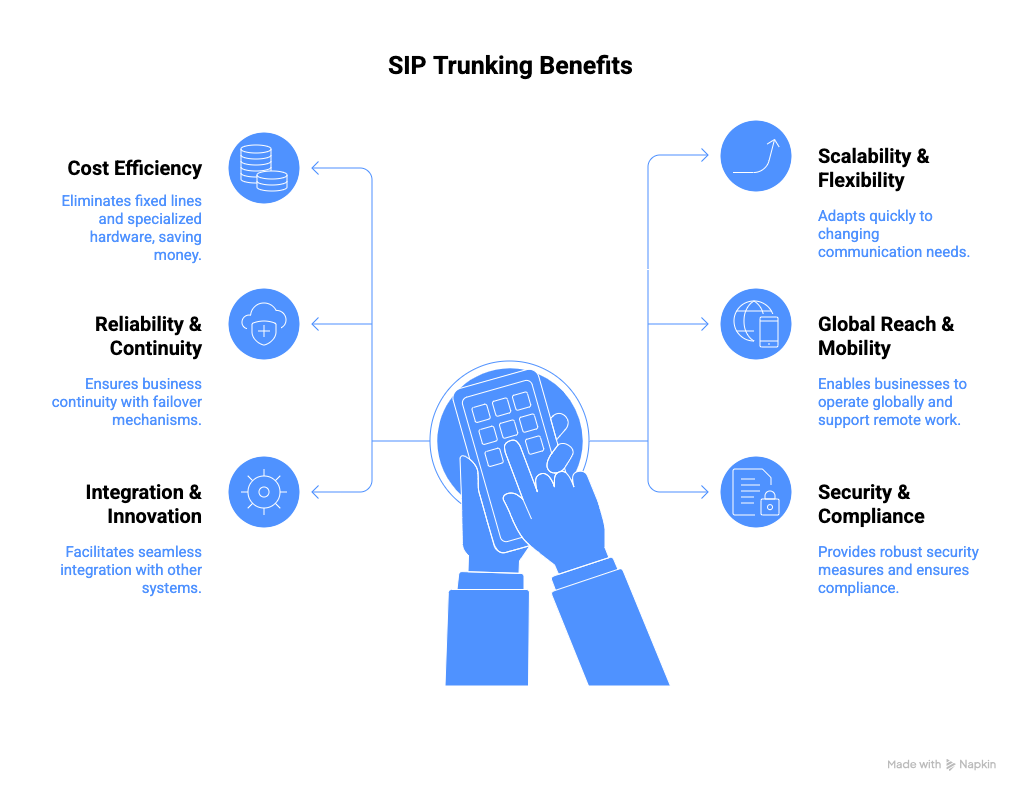
1. Cost Efficiency
SIP trunking replaces costly and rigid telecom infrastructure with a smarter, more flexible model. There’s no need for expensive PRI circuits, hardware-heavy setups, or dedicated copper lines because everything runs through your existing internet connection.
Because calls are routed over IP, you reduce long-distance and international costs. Best of all, SIP trunking operates on a pay-as-you-grow model: you only pay for the channels you need, and you can scale up or down without re-contracting or rewiring.
2. Scalability & Flexibility
Traditional phone systems can’t match the adaptability of SIP trunking. Adding or removing channels takes minutes with no technician appointments or hardware upgrades required. Whether you’re onboarding a remote team, spinning up a new office, or experiencing seasonal call spikes, your infrastructure adjusts in real-time.
3. Reliability & Business Continuity
SIP trunking ensures your voice service stays online even when the unexpected happens. Built-in failover routing automatically redirects calls to backup lines or locations if your primary system goes down. Geographic redundancy ensures you’re not tied to a single site or server. And because it’s cloud-based, SIP trunking delivers consistent uptime regardless of where your teams are or what device they use.
4. Global Reach & Mobility
Your business goes global without needing local offices or complex infrastructure. You can instantly activate local phone numbers (DIDs) in dozens of countries, helping you establish presence and trust in new markets. Employees working remotely, traveling, or split across continents can make and receive business calls from anywhere, all under the same system.
5. Integration & Innovation
It integrates seamlessly with UCaaS platforms, CRMs, contact centers, and other business-critical applications. You can enable modern features like click-to-call, live call analytics, AI-driven transcription, or even route voice traffic based on CRM data. SIP becomes part of your larger tech ecosystem, helping you automate, optimize, and innovate without friction.
6. Security & Compliance
SIP trunking offers enterprise-grade protection with built-in encryption (TLS and SRTP), fraud monitoring, and Session Border Controllers (SBCs) that block threats like toll fraud and DDoS attacks. Leading providers also ensure full compliance with telecom and data regulations such as GDPR, HIPAA, and regional number portability rules.
SIP Trunking vs Traditional Phone Lines
SIP trunking represents a leap forward from legacy telecom setups like PRI (Primary Rate Interface) and ISDN (Integrated Services Digital Network). These older systems rely on physical copper lines installed on-site, which means they’re expensive to maintain, hard to scale, and rooted in one physical location. They simply weren’t built for hybrid teams, global offices, or real-time business agility.
By contrast, SIP trunking uses the internet to carry voice calls, eliminating the need for physical infrastructure. It connects your PBX (on-prem or cloud) to the public telephone network (PSTN) via virtual “trunks” that can be scaled instantly.
So, What Does That Actually Mean for Your Business?
You don’t need to wait weeks for a technician to install lines every time your team grows.
You can operate across cities or continents without opening new phone contracts in each location.
You can slash monthly telecom bills, especially if you handle international or high-volume calls.
You gain control over your voice infrastructure, with modern tools for routing, failover, analytics, and integration.
Comparison Table: SIP Trunking vs Traditional Phone Systems
| Feature | SIP Trunking | Traditional Phone Lines (PRI/ISDN) |
|---|---|---|
| Technology | Internet-based (VoIP + SIP) | Physical copper circuits |
| Setup Time | Rapid (often within hours/days) | Slow (technician installation required) |
| Scalability | Instantly scalable (add/remove channels) | Limited to fixed lines |
| Cost | Lower CAPEX + OPEX, pay-per-use | High setup & maintenance costs |
| Geographic Flexibility | Global numbers, remote-ready | Tied to physical locations |
| Maintenance | Minimal (cloud-based / remote management) | High (hardware failures, on-site service) |
| Call Quality | High with QoS + modern codecs | Consistent, but not flexible |
| Business Continuity | Built-in failover and redundancy | Vulnerable to outages |
| Integration Capabilities | Strong (UCaaS, CRMs, APIs, analytics) | Very limited |
| Security Features | Encryption, SBCs, fraud detection | Minimal |
| Global Availability | Yes (instant local/international numbers) | Limited (requires local infrastructure) |
Who Uses SIP Trunking?
SIP trunking is used by a wide range of businesses, from agile startups to enterprise giants, because it solves one of the biggest pain points in modern communication: how to stay connected, flexible, and cost-efficient across teams, locations, and borders.
It’s not just for telecom-savvy companies or call centers. In 2025, SIP trunking is the backbone of any business that needs scalable, reliable voice communication without the headache of legacy infrastructure.

SIP Trunking is Used By:
 Remote or distributed teams
- Call centers handling high-volume traffic
- Global businesses with multi-country presence
- SMBs that want enterprise-grade calling without the price tag
Let’s Break It Down:
Remote / Distributed Teams
SIP trunking allows remote employees to make and receive business calls from anywhere: whether they’re at home, in a coworking space, or halfway around the world. Softphones, mobile apps, and browser-based dialers connect them to the same PBX system used in-office, ensuring consistent communication and a seamless experience for both staff and customers.
Call Centers (Inbound & Outbound)
SIP trunking was practically made for call centers. Its ability to handle high call volumes, route traffic intelligently, and scale in real time makes it a top choice for customer service and sales teams. Businesses can onboard or offboard agents instantly, route calls based on availability, language, or location, and never worry about hitting a capacity ceiling. It’s the backbone for contact centers that prioritize uptime, quality, and agility.
Global Businesses
Expanding internationally no longer means wrangling multiple telecom providers in every country. SIP trunking allows businesses to activate local phone numbers (DIDs) across borders, route calls globally with minimal latency, and comply with local telecom regulations, all from one provider
Small and Mid-Sized Businesses (SMBs)
SIP trunking unlocks enterprise-grade features without enterprise-grade price tags. You can start with just a few channels, avoid hardware investments, and access features like IVR, call analytics, voicemail-to-email, and call recording right out of the box. More importantly, it lets you grow without switching providers or overhauling infrastructure — perfect for ambitious teams with limited IT resources and a sharp eye on cost.
How to Start with SIP Trunking?
Getting started with SIP trunking might sound complex, but with the right provider, it’s a lot smoother than you think. Here’s a step-by-step roadmap to help you migrate from legacy phone systems to modern, internet-based voice communication.
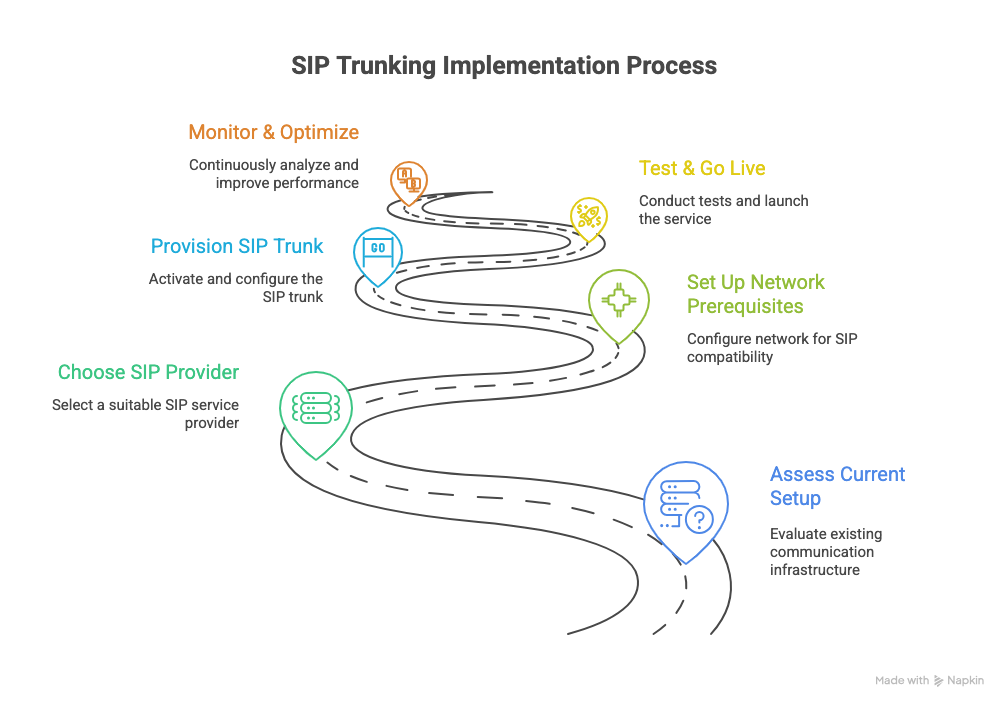
Step 1 – Assess Your Current Setup
Before jumping in, take stock of what you’re working with:
PBX System: Is it on-premises or cloud-based? Is it SIP-compatible?
Internet Bandwidth: Can it handle multiple concurrent calls alongside your usual data traffic?
Network Readiness: Are your routers, switches, and firewalls optimized for VoIP traffic?
Call Volume: How many simultaneous calls do you handle at peak? This determines your required SIP channels.
Step 2 – Choose Your SIP Provider & Procure Trunks
Find a provider that matches your needs in:
Coverage: Do they support the regions you operate in?
Pricing: Transparent, scalable, and easy to understand?
Support: 24/7 assistance, onboarding guidance, and clear SLAs?
Features: Redundancy, DIDs (Direct Inward Dialing), number porting, analytics, etc.
Once you decide, you’ll purchase the number of SIP channels you need to start.
Step 3 – Set Up Network Prerequisites
Voice traffic is sensitive to network hiccups. Your IT team (or Telxi’s engineers) will:
Prioritize voice packets with QoS (Quality of Service) settings
Configure firewalls and SBCs to securely manage SIP sessions
Check for latency, jitter, and packet loss thresholds to maintain HD call quality
 Best practice: Always overprovision bandwidth by 20–30% during peak call hours.
Step 4 – Provision the SIP Trunk
Now it’s time to configure the SIP trunk with your PBX or voice platform:
Assign channels based on expected concurrent call volume
Configure DIDs / phone numbers
Set up inbound and outbound call routing rules (e.g., call groups, extensions, failover logic)
Step 5 – Test & Go Live
Before flipping the switch:
Run test calls internally and externally to check audio quality, latency, and call handling
Conduct failover testing to confirm backup routing is in place
Port your existing numbers from legacy carriers (with minimal downtime)
Step 6 – Monitor, Analyze & Optimize
Once you’re live, the work doesn’t stop — it evolves:
Use real-time analytics to monitor usage, peak times, and call quality
Scale SIP channels up or down based on trends
Adjust routing, prioritize regions, or reallocate numbers as your business grows
Review monthly costs and optimize based on call patterns
Common SIP Trunking Mistakes & Pitfalls
SIP trunking is a major upgrade, but if you cut corners during setup or overlook critical details, you can end up with poor call quality, downtime, or a messy migration. Here are the most common mistakes businesses make when deploying SIP trunking, and how to avoid them.
1. Underestimating Bandwidth & Network Readiness
Voice calls get choppy or drop completely because your internet connection isn’t optimized for SIP. This happens because teams forget that voice traffic competes with everything else on the network — video calls, file transfers, cloud backups.
Fix It:
Run a network assessment before go-live
Prioritize voice traffic with QoS (Quality of Service)
Use dedicated bandwidth or VLANs for voice
Overprovision internet capacity by 20–30% over peak usage
2. Skipping Failover & Redundancy Planning
A single point of failure (ISP outage, PBX crash) brings down your entire phone system. This happens because businesses assume internet-based systems are “always up,” or they delay backup planning until after something breaks.
Fix It:
Implement automatic failover routing to backup SIP trunks or mobile endpoints
Use multiple ISPs or a provider with geographic redundancy
Test your disaster recovery plan regularly — not just on paper
3. Choosing a Provider Based Purely on Price
Cheap SIP providers can mean poor call quality, limited support, or surprise charges. Budgets get tight, and pricing gets oversimplified, but cost per channel or minute doesn’t tell the whole story.
Fix It:
Vet providers for call quality guarantees, support SLAs, and international reach
Ask about hidden costs (number porting fees, international call surcharges, support tiers)
Focus on total value, not just the sticker price
4. Poor Security & No SIP-Level Protection
Your voice network can become a target for fraud, toll abuse, or DDoS attacks. SIP runs over the internet, but businesses don’t always apply the same security standards as they would for data.
Fix It:
Use Session Border Controllers (SBCs) to manage SIP traffic securely
Enable encryption (TLS/SRTP)
Set up rate limits, IP restrictions, and real-time traffic monitoring
Choose a provider like Telxi that actively mitigates fraud at the network level
5. Messy or Delayed Number Porting
You can lose access to critical phone numbers during the migration, causing downtime and missed calls. This is because of the poor coordination between carriers, unclear porting timelines, or incomplete documentation.
Fix It:
Start porting early — it often takes 1–4 weeks
Work with a provider that handles number management and carrier coordination
Test numbers thoroughly before the switchover
6. Lack of Team Training & Internal Adoption
When your new SIP setup launches, but no one knows how to use the features, it leads to frustration or underuse. Sometimes this occurs because of too much focus on the tech side, not enough on change management or user experience.
Fix It:
Run quick internal onboarding sessions on new tools and processes
Document extension dialing, voicemail setup, call routing rules, etc.
Choose a provider with supportive onboarding materials or training resources
Best SIP Trunking Providers
Here are five leading SIP trunking providers and a snapshot of what each brings to the table:
Telxi — Positioned for global reach, transparent pricing, enterprise‑grade infrastructure, and simplified onboarding.
Twilio — Developer‑friendly, strong for API‑driven voice, global capacity.
RingCentral — Broad unified‑communications stack, integrates voice/SIP with UCaaS, global markets.
Vonage — Known for transition support from legacy to SIP, strong number‑porting, and global access.
Nextiva — Focused on growing businesses with cost‑efficient SIP, a familiar interface,and good support.
How To Choose the Right SIP Trunking Provider?

When you’re choosing a SIP trunking provider, you’re not just buying voice lines: you’re buying a communication backbone. Here is what you need to know:
1. Quality of Service (QoS) & Performance
Look for providers that guarantee low latency, minimal jitter, and virtually no packet loss. A strong provider should have a geo-redundant, carrier-grade network infrastructure optimized specifically for real-time voice. Even better? Real-time monitoring tools and clearly defined SLAs that give you visibility and accountability over call performance.
2. Scalability & Flexibility
Can you spin up new channels on demand, or scale down during low-usage periods? Does the provider lock you into rigid packages or allow for true pay-as-you-go pricing? A future-ready provider will make it easy to handle growth spikes, seasonal fluctuations, or international expansion without waiting weeks for provisioning.
3. Global Coverage & Routing
Your provider must support international Direct Inward Dialing (DIDs) and deliver consistent call quality around the globe. That means local number availability, knowledge of regional telecom compliance, and routing through Tier 1 carriers. Anything less and you risk dropped calls, bad latency, and regulatory headaches. Global-grade business requires global-grade routing.
4. Security & Compliance
Without proper protection, they’re vulnerable to toll fraud, DDoS attacks, and interception. A serious provider will include TLS and SRTP encryption, actively monitor traffic for anomalies, and deploy Session Border Controllers (SBCs) as standard. They should also be compliant with regulations like GDPR, HIPAA, or STIR/SHAKEN, depending on your industry and region.
5. Support & SLAs
The right SIP provider offers 24/7 live support with clear escalation paths and fast response times. Look for providers that back their reliability promises with contractual uptime SLAs and the infrastructure to support them.
6. Transparent Pricing
Some providers hide fees in the fine print: charges for porting numbers, activating DIDs, using backup routes, or simply exceeding soft limits. Choose a provider that makes pricing easy to understand, shows rates clearly, and helps you forecast your monthly spend without surprises. Transparent pricing is what enables predictable scaling.
7. Integration & Compatibility
Whether you use an on-prem PBX, a cloud UCaaS solution, or run a full API-driven communications layer, your provider should support native integration or offer simple provisioning through APIs. Bonus points if it plugs into your CRM or contact center software to streamline voice workflows.
Questions to Ask During Evaluation
Before you commit, ask:
How long does number porting take? Are there any fees?
What happens if my primary connection goes down?
Do you support multiple locations or global offices?
What are your uptime guarantees? Can I see your SLA?
How do you handle call failover and redundancy?
Are support tiers included, or charged separately?
Why Companies Choose Telxi?
Telxi is purpose-built for modern, global businesses — especially those in fast-moving sectors like B2B SaaS, tech, and customer experience.
Here’s why businesses choose Telxi:
Global Routing Backbone
Carrier-grade voice with local numbers in 100+ countries. Call routing optimized for clarity and speed across borders.Transparent Pricing
No setup fees, no hidden costs, no channel minimums. You scale and pay only for what you use.Enterprise-Grade Infrastructure
Built for resilience, scale, and security — including built-in SBCs, fraud monitoring, and regulatory compliance across regions.SaaS-Ready
Works seamlessly with cloud PBX, UCaaS platforms, CRMs, and any API-driven comms stack.Real Support, Real People
24/7 support with onboarding assistance and fast SLAs.
Contact Telxi Sales Team Now
SIP Trunking Pricing Insights – What to Expect in 2026
When planning a move to SIP trunking, understanding the pricing landscape is key. The cost is influenced by several factors — but with smart evaluation, you can budget confidently and avoid surprises.
Typical Cost Ranges & Pricing Models
Most businesses paying for a SIP channel (one concurrent call path) should expect somewhere in the US $15‑25 per channel per month range.
Some plans list up to US $30 or more per channel/month for high‑end or unlimited usage tiers.
Pricing models generally fall into two types:
Per‑channel model: Fixed fee per channel + variable per‑minute rates (especially for international calls)
Unlimited/flat‑rate model: Fixed monthly fee per channel covering unlimited domestic usage (often US & Canada) with international usage often extra.
Key Cost Drivers
Several elements affect how much you’ll pay — not just the channel count.
Number of concurrent calls = number of channels required. More channels = higher base cost.
Outbound/inbound call volumes and destinations: International calling, toll‑free numbers, premium destinations cost more.
Direct Inward Dial numbers (DIDs) / local numbers: Monthly cost per number, sometimes porting fees.
Setup & one‑time fees: Some providers charge activation, porting, hardware/gateway fees.
Quality, coverage & support level: Premium providers with global routing, geo‑redundancy, SLAs may charge more.
How to Estimate Your Monthly Cost
You need to take this into account to better understand how your costs:
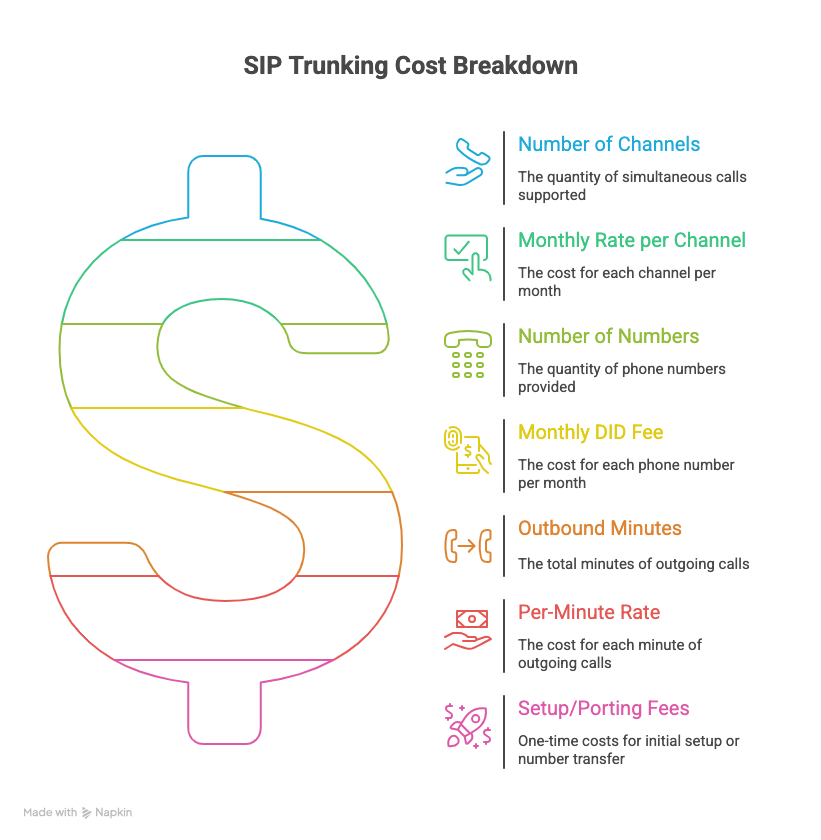
Example:
You need 20 simultaneous calls → 20 channels.
Rate: US $20/channel/month → 20 × 20 = US $400.
You use 10 DIDs at US $1 each → US $10.
Outbound international usage 1 000 minutes at US $0.02/min → US $20.
Setup fee one‑time US $150.
→ Estimated first‑month cost: US $400 + US $10 + US $20 + US $150 = US $580.
→ Recurring cost next months: ~US $430 (assuming similar usage).
Advanced Use Cases & Future Trends in SIP Trunking
SIP trunking is the launchpad for the future of business communication. In 2026, forward-looking companies are leveraging SIP to power everything from real-time analytics to voice-driven customer experiences.
Here’s how SIP trunking is evolving and why making the switch now future-proofs your communications stack.
Integration with UCaaS, APIs & Call Intelligence Platforms
Modern businesses run on connected tools — and SIP trunking is the connective tissue. The right SIP setup can:
Integrate seamlessly with UCaaS platforms (like Zoom Phone, Microsoft Teams, RingCentral) for unified voice, video, and messaging.
Plug into CRM platforms (like Salesforce or HubSpot) to trigger customer insights during live calls.
Enable call analytics and voice recording platforms to improve agent performance, QA, and compliance.
Deliver click-to-call functionality and real-time call routing using APIs.
Hybrid Workforce & Global Connectivity
In the post-pandemic world, businesses must support communication across time zones, devices, and office walls. SIP makes this possible by:
Letting remote or hybrid employees make and receive business calls from any device — no VPN or hardware required.
Supporting mobile softphones, desk phones, browser-based dialers, or UCaaS tools — all connected via the same trunk.
Enabling global extension dialing, call transfers, and shared routing rules regardless of location.
AI, Machine Learning & Real-Time Voice Intelligence
SIP trunking acts as the voice delivery layer for:
Real-time transcription & call summaries
Sentiment analysis to flag churn risk or escalations during live calls
AI-powered coaching tools that evaluate tone, talk time, and effectiveness
Voicebots for call routing, FAQ deflection, and lead capture
5G, IoT & New Communication Media
With 5G and IoT gaining traction, SIP is being used to enable:
Embedded voice in devices (think smart kiosks, medical alert systems, logistics hubs)
Secure, low-latency voice over 5G for mobile-heavy environments
Voice-triggered workflows in smart buildings, contactless environments, and edge computing platforms
Looking for a SIP Trunking Provider?
If you’re ready to modernize your business communications, Telxi makes the transition simple. Whether you’re migrating from legacy systems, expanding globally, or just tired of overpaying for underwhelming voice service, Telxi gives you the infrastructure, support, and transparency to communicate smarter.


