
In this guide, we’ll break down exactly what toll-free numbers are, how they work, their benefits and why they remain a key piece of the global communications puzzle in 2026.
What Are Toll-Free Numbers?
A toll-free number is a phone number that lets callers reach your business without paying for the call; the business absorbs the cost instead. These numbers typically begin with special prefixes like 800, 888, or 877 and are designed to remove barriers for customer communication.

Originally developed for traditional phone lines (PSTN), toll-free numbers have since evolved to work over internet-based systems like VoIP and SIP trunking. This shift makes them far more flexible, cost-efficient, and globally accessible than their legacy counterparts.
Example: When someone calls 1-800-FLOWERS, they don’t pay anything — the company does. That same number can now route through a VoIP platform, connect to any device, and forward calls across teams or time zones in seconds.
How Toll-Free Numbers Work
Toll-free numbers work by reversing the cost of a call: instead of the caller paying, the business that owns the number covers the charge. When a customer dials a toll-free number, the call is intercepted by the telecom carrier, routed through a SIP trunk or VoIP provider, and then delivered to the business’s phone system (PBX or VoIP platform).

How Calls Are Routed Globally via VoIP
In modern systems, toll-free calls don’t just travel through copper wires — they pass through global VoIP infrastructure, making them faster, smarter, and easier to scale.
Here’s what the call flow typically looks like:
-
Caller: Initiates the toll-free call from any phone or device.
-
Toll-Free Prefix: Determines the call’s routing logic based on region.
-
Carrier: Connects the call to a SIP trunk provider.
-
SIP Trunk: Bridges the call into your VoIP system securely and reliably.
-
VoIP PBX: Routes the call to the correct team, extension, or device — anywhere in the world.
-
Agent/Department: Answers the call via softphone, IP desk phone, or mobile app.
5 Key Benefits of Toll-Free Numbers for Businesses
Toll-free numbers improve customer experience, build brand credibility, and help businesses scale globally with minimal friction. Here’s what makes them valuable:
Free and Easy Access for Customers
A toll-free number removes the cost barrier for your customers. When someone dials your 800 (or equivalent) number, they’re not charged. This simple shift in who pays makes a huge difference, especially in competitive markets where even a minor inconvenience can prevent someone from reaching out.
Whether you’re in eCommerce, B2B sales, or customer support, making it free for prospects and clients to call improves contact rates and increases inbound engagement.
Builds Trust and Professional Image
Having a toll-free number immediately signals credibility. Customers often associate these numbers with established companies and assume they’ll be routed to a professional call center or knowledgeable rep.
It also makes your brand feel larger, more organized, and more accessible, even if you’re a lean team working across time zones.
Marketing & Call Tracking
Toll-free numbers are highly trackable, making them a powerful tool for marketing campaigns. You can assign unique toll-free numbers to different ads, landing pages, or regions, and analyze call volume, duration, and outcomes from each.
This lets you:
Attribute leads to specific campaigns
A/B test marketing efforts
Optimize your ad spend based on inbound call performance
Pair this with VoIP call analytics, and you get deep insight into which campaigns are actually driving conversations and revenue.
Global Scalability via VoIP
Combined with cloud telephony and SIP trunking, toll-free numbers can be routed, managed, and scaled globally without physical infrastructure.
This means you can:
Activate toll-free numbers in multiple countries
Route them all to a single or distributed contact center
Centralize or localize customer experience without hardware
It’s how modern brands offer global support with a unified voice system.
Seamless CRM & Call Center Integration
Modern toll-free numbers integrate easily into CRMs, helpdesks, and contact center platforms. This allows agents to see caller history, trigger workflows automatically, and personalize the interaction the moment a call begins.
Integrations can enable:
Screen pops with customer details during incoming calls
Auto-logging of calls and notes into CRM records
Automated ticket creation for missed calls or voicemails
Real-time call routing based on CRM data (e.g., region, lead status)
Types of Toll-Free Numbers
There are different types depending on where your customers are, how your business operates, and what kind of brand experience you want to deliver.
Domestic Toll-Free Numbers
These are the ones that work within a single country. For example, a U.S. customer can call a U.S. toll-free number (like 1‑800‑XXX‑XXXX) without being charged, but the same number won’t work if dialed from another country.
They’re perfect for:
-
Local businesses serving national audiences
-
Customer support lines in one region
-
Marketing campaigns targeted to a single market
But they don’t provide any value for international callers, which can limit accessibility for global businesses.
International Toll-Free Numbers (ITFS / UIFN)
ITFS (International Toll-Free Service) numbers let callers from one country reach your business in another country without incurring charges. For example, a customer in Germany could call a Germany-based toll-free number that routes to your U.S. call center.
UIFN (Universal International Freephone Number) offers a single toll-free number accessible in multiple countries, but it comes with strict formatting and carrier restrictions. It’s less flexible and more expensive than ITFS.
These numbers are ideal for:
-
Multinational companies offering support across regions
-
Global sales and customer service teams
-
Cross-border marketing campaigns
Vanity Toll-Free Numbers
Vanity numbers use custom letters or memorable digit combinations (e.g., 1‑800‑FLOWERS) that align with your brand or product. They’re primarily domestic but provide significant marketing and branding benefits.
They help:
-
Improve brand recall
-
Boost ad campaign performance
-
Appear more professional and polished
The challenge? Availability — good vanity numbers are hard to find and can cost more to register.
Virtual Toll-Free Numbers in Cloud Systems
These are VoIP-powered toll-free numbers hosted in the cloud and not tied to physical infrastructure. You can route them dynamically, assign them to remote teams, and manage everything from a central dashboard.
They allow:
-
Instant provisioning and activation
-
Easy routing to SIP trunks or cloud-based PBX systems
-
Full integration with modern CRM and analytics platforms
Virtual toll-free numbers are the go-to solution for global, remote-first, or digitally native businesses.
Toll-Free Number Types Comparison Table
| Type | Reach | Best For | Key Advantage | Key Limitation |
|---|---|---|---|---|
| Domestic Toll-Free | Within a single country | National support or sales | Easy to set up, low cost | Doesn’t work internationally |
| International Toll-Free (ITFS) | Cross-border (caller country matches number) | Global support, multi-country presence | Customers abroad can call free | Requires country-specific setup |
| UIFN | Multiple countries (limited) | Global branding | One number for multiple countries | Carrier limitations, setup complexity |
| Vanity Toll-Free | Primarily domestic | Marketing and brand recognition | Memorable and brand-aligned | Hard to acquire, sometimes costly |
| Virtual Toll-Free (VoIP) | Global (via internet) | Cloud-first and distributed businesses | Scalable, easy routing & control | Dependent on VoIP infrastructure |
How to Get a Toll-Free Number
Setting up a toll-free number for your business is easy, especially with cloud-based providers that handle the complexity behind the scenes. Here’s how the process works:
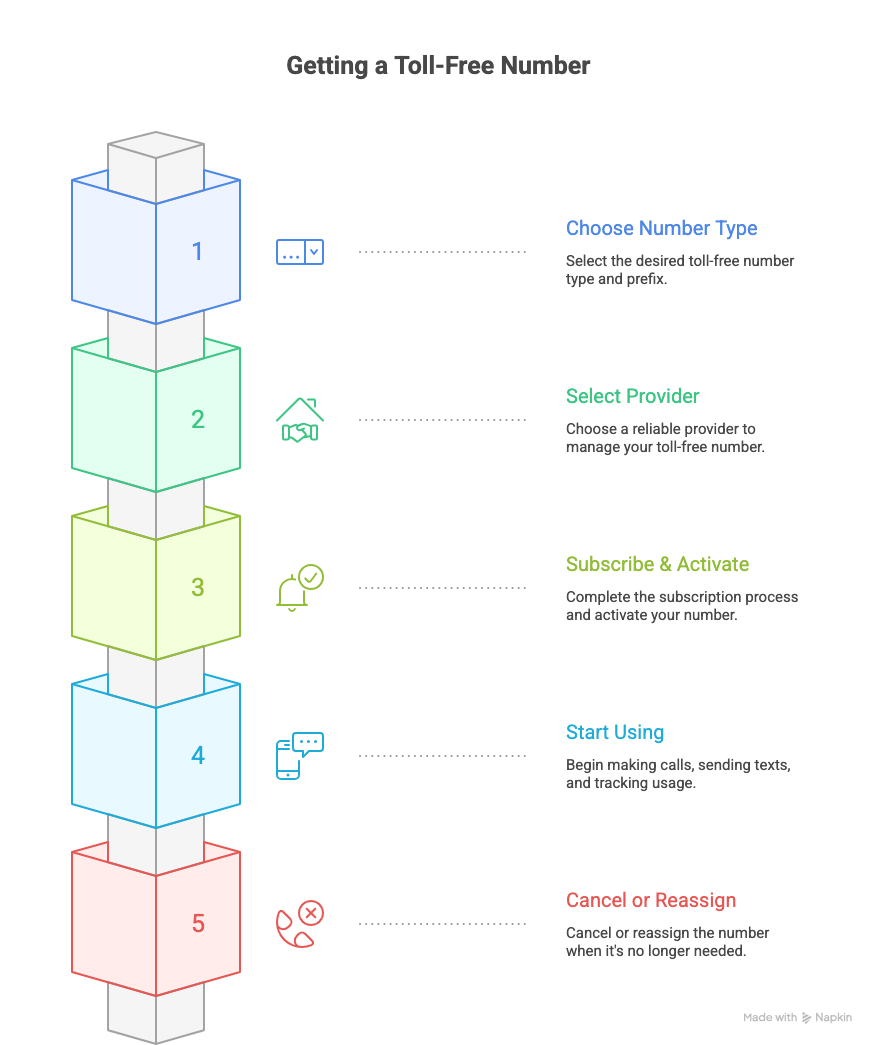
Step 1: Choose Your Toll-Free Number Type and Prefix
Start by selecting the type of toll-free number you want:
-
Domestic, international, or virtual toll-free numbers?
-
Prefer a memorable vanity number like 1‑800‑GROWTH?
-
Want a specific prefix? (e.g., 800, 888, 877, 866, 855, 844, 833)
While 800 is the classic go-to, many of those numbers are already claimed. Newer prefixes offer the same toll-free function and greater availability — without sacrificing credibility.
Step 2: Select a Provider
A Responsible Organization (RespOrg) is a certified provider authorized to assign and manage toll-free numbers. Most VoIP and telecom companies act as RespOrgs, but not all offer the same capabilities — so it’s worth comparing.
When choosing a provider, consider the following:
-
Coverage: Do they offer domestic and international toll-free numbers?
-
Scalability: Can they support multiple numbers and high call volumes as your business grows?
-
Compliance: Are they familiar with regulatory requirements in the countries you serve?
-
Porting support: Can they help you move existing numbers with minimal downtime?
-
Integration options: Do they support SIP trunking, call routing, and CRM/call center tools?
If your current provider isn’t a certified RespOrg, you can search for authorized organizations at www.somos.com
Step 3: Subscribe to and Activate the Number
Once you’ve selected a number, the provider assigns it to your account.
From your admin dashboard, you can:
-
Route the number to specific users or departments
-
Link it to your existing SIP trunk or VoIP PBX
-
Configure voicemail, IVR, auto attendants, and more
You can even assign multiple numbers for different markets or campaigns.
Step 4: Start Calling, Texting, and Tracking
After activation, the number is live. Use it to:
-
Accept incoming calls from customers across regions
-
Text-enable it (where supported) for SMS support
-
Track performance by assigning numbers to different campaigns
If you’re using Telxi, you can manage all this through a single portal, making toll-free just another part of your cloud voice stack.
Step 5: Cancel or Reassign When You No Longer Need It
Need to retire a number? Simply release it through your account dashboard or contact support. Your number goes back to the toll-free database and can eventually be recycled.
Implementation & Best Practices
Setting up a toll-free number is about integrating it into your communication infrastructure properly, securely, and cost-effectively. Here’s what to know before you go live.
Compliance & Portability Considerations
Toll-free numbers are regulated differently depending on the region. In the U.S., they’re governed by the FCC, while other countries have their own telecom authorities and rules around number ownership, porting, and call routing.
Key best practices:
-
Always verify local regulations when buying international toll-free numbers (ITFS).
-
Work with a provider that’s a certified RespOrg and understands regional compliance.
-
Porting toll-free numbers between providers can take days to weeks, so plan your migrations carefully to avoid downtime.
-
Make sure you own the number contractually to maintain control if you switch providers.
SIP / PBX Integration for Toll-Free Routing
If your business uses a VoIP PBX or SIP trunking setup, your toll-free numbers need to be mapped correctly:
-
Inbound routing: Configure the number to point to your SIP trunk or hosted PBX platform.
-
Failover paths: Ensure backup call paths are set up in case your main route fails.
-
Routing rules: Route calls based on time of day, geography, department, or IVR selection.
-
CRM/UCaaS links: Integrate with tools like HubSpot, Salesforce, or your call center software.
Common Pitfalls
Here are some pitfalls to watch out for:
-
Mobile restrictions: In some countries (e.g., certain LATAM or APAC regions), toll-free numbers may not be reachable from mobile phones unless explicitly enabled.
-
Geographic limitations: Not all toll-free numbers are “universal.” An international toll-free number for France won’t work in Germany unless separately configured.
-
Caller ID issues: Some toll-free carriers don’t always preserve full caller ID, which can affect call tracking or CRM integration.
-
Voice-only numbers: Not all toll-free numbers support SMS — double-check if texting is a must-have.
Billing Models and Cost Optimization Tips
Knowing how your billing works can save you a lot over time:
Billing models:
-
Per-minute rates by country and type of caller (landline vs mobile)
-
Flat-rate packages (limited in availability, often domestic only)
-
Bundled minutes or tiered usage plans from providers like Telxi
Cost-saving tips:
-
Use local DIDs alongside toll-free numbers in countries where mobile toll-free access is expensive.
-
Limit toll-free availability to core markets; don’t overspend on global access where you don’t operate.
-
Monitor usage monthly and adjust plans or routing rules to reduce unnecessary spend.
-
Route low-priority calls (e.g., FAQs or support tickets) to IVRs or chatbots before human agents.
Who Needs Toll-Free Numbers?
They’re a valuable asset for any business that wants to be more reachable, trustworthy, and customer-centric. Here are some examples:

1. Customer Support Teams
If your business handles a high volume of inbound calls, a toll-free number makes it easy for people to reach you. It reduces friction and builds goodwill by covering the cost of the call.
2. E-commerce & Retail Brands
Online shoppers often have pre-sale questions or post-sale concerns. A toll-free number adds credibility to your website and lets customers call you from anywhere, which increases trust and conversion rates.
3. B2B SaaS & Tech Providers
When you’re selling software or digital services, support matters. Toll-free numbers are essential for onboarding assistance, tech support, and maintaining a reliable support line across multiple regions — without forcing your clients to pay for it.
4. Global Businesses
Operating internationally? A single toll-free number lets customers in different countries reach you without dialing expensive international lines. You sound local, no matter where you are.
5. Financial & Legal Services
Trust is critical in finance, insurance, or law. Toll-free numbers project professionalism, signal legitimacy, and allow clients to reach you quickly during sensitive or high-stakes situations.
6. Marketing & Campaign-Driven Teams
Toll-free numbers are easily trackable. You can assign different numbers to different campaigns, regions, or ads, making it simple to measure ROI and see what’s working.
7. Small Businesses Trying to Appear Bigger
Even if you’re a lean team, a toll-free number gives the appearance of a large presence. It adds polish, credibility, and reach without needing a physical office in every market.
Cost of Toll-Free Numbers
The costs can vary depending on your provider, the type of service (VoIP vs landline), and the volume of calls you handle.
Here’s a breakdown of the typical cost structure:
1. Subscription Fees
Most providers charge a monthly fee per toll-free number. With VoIP platforms, this usually ranges from $5 to $20 per month, depending on the region and whether you’re using a standard or vanity number.
2. Usage Costs
Since the business pays for incoming calls, you’ll be billed based on total minutes used. International toll-free calls and high volumes can increase these costs — but many VoIP plans bundle minutes or offer volume discounts to control spending.
3. Setup Costs
With VoIP systems, setup is instant and hardware-free. No cables, no desk phones, no installation visits. Traditional landline systems may require equipment and infrastructure — which can cost hundreds of dollars.
–>Want a clear estimate tailored to your needs? Use Telxi’s free call cost calculator to see exactly what you’d pay
How to Implement a Toll‑Free Number with Telxi
Getting your toll‑free number up and running with Telxi is quick, straightforward, and designed for modern businesses — no hardware racks, long lead times, or complex paperwork needed. Here’s how you can do it in five simple steps:
Step 1 – Create or Log Into Your Telxi Account
Start by signing into your Telxi dashboard or, if you’re new, select your plan and get started now. Telxi’s portal is built for self‑serve number provisioning, so once you’re in, you’re ready to go.
Step 2 – Select Your Toll‑Free Number
In the portal, navigate to the Phone Numbers section (which covers local, mobile and toll‑free numbers). Choose the toll‑free option and browse available prefixes and numbers for your target region. Telxi supports toll‑free numbers across many international markets.
Step 3 – Configure Routing and SIP Integration
Once the number is selected, set how incoming calls should be routed:
-
Connect it to your SIP trunk or cloud PBX
-
Define extensions, auto attendants, IVRs or call queues
-
Set up failover routing in case of connectivity issues
Telxi’s network supports SIP‑based routing, making it compatible with your existing voice setup.
Step 4 – Go Live and Accept Calls
After routing is configured, your toll‑free number is live. You can immediately start receiving calls from customers — anywhere supported across your selected regions. Use Telxi’s dashboard to monitor usage, view call records and analyse performance.
Step 5 – Review Usage and Optimise
With your toll‑free number running, keep a periodic review of call volumes, cost per minute (especially for international callers), and routing efficiency. Telxi’s pricing starts from very competitive tiers and allows you to scale or change as needed.
I chose Telxi for my SIP trunk DID number provider after reviewing a number of its competitors. They don’t have any monthly minimum charges and you pay as you go. Only $1 a month for a DID number with no monthly minimums made Telxi my choice. After testing it for couple of days I found it working great. I configured it with my FREE 3CX (10 Users) account and got myself a free hosted Phone System. That’s awesome! Trust Pilot Review
What are the Most Common Prefixes by Region?
| Region | Toll-Free Prefix | Notes |
|---|---|---|
| United States & Canada | 800 | Most recognized traditional toll-free prefix |
| United States & Canada | 888 | Introduced for additional toll-free availability |
| United States & Canada | 877 | Alternative toll-free prefix in NANP |
| United States & Canada | 866 | Used across U.S. and Canada |
| United Kingdom | 0800 | Standard toll-free prefix in the UK |
| Australia | 1800 | Primary Australian toll-free number |
| Germany | 0800 | Used for national toll-free services |
| Japan | 0120 | Standard toll-free number for businesses |
| India | 1800 | India’s national toll-free prefix |
| Brazil | 0800 | Used widely in Brazil for free customer calls |
FAQs About Toll-Free Numbers
- How many toll-free numbers can my business have?
There’s no hard limit. You can register as many toll-free numbers as your business needs — whether it's one number for your entire company or dedicated lines per department, region, or marketing campaign.
- Can I change my toll-free number?
Yes. You can change or swap your toll-free number by working with your provider or RespOrg. Just make sure you communicate the change to your customers and update it across all touchpoints.
- Can I keep my toll-free number if I change providers?
Yes. Thanks to number portability, you can transfer (port) your toll-free number to another provider. Just ensure your new provider is a registered RespOrg and supports porting.
- Are toll-free numbers text-enabled?
Many modern toll-free numbers — especially when provisioned via VoIP platforms — can send and receive SMS, depending on your provider’s capabilities.


