
This guide will walk you through why international calls are still so costly on legacy setups like PRI, how VoIP, SIP trunking, and Voice Termination can structurally lower your international call costs by 30–90% and what you’ll need to transition safely to a modern, scalable setup.

Whether you’re just starting to question your monthly bill or ready to upgrade your communications stack, this guide will give you a clear, business-focused roadmap to save money and modernize your international calling setup.

In this post:

TL;DR – How to Reduce International Call Costs for Your Business

  • Legacy systems like PRI and PSTN are expensive by design, especially for international traffic because you’re paying for fixed capacity and outdated pricing models.

  • VoIP and SIP trunking lower costs dramatically by routing calls over the internet and offering more flexible pricing (pay-as-you-go, bundles, global plans).

  • With the right setup, you can save 30–50% on total telephony spend, and up to 90% on international calls, without sacrificing call quality.

  • Tools like Voice Termination and virtual numbers help you scale global communications while staying in control of your budget.

  • Telxi helps businesses transition smoothly, offering transparent pricing, modern infrastructure, and global coverage.

Why Your International Calls Are Still So Expensive?

Many businesses still relying on traditional phone systems (like PRI or PSTN), so international call costs can feel unpredictable, bloated, and increasingly hard to justify.

Outdated telecom contracts, fixed-line setups, and rigid per-minute billing models often result in charges that are far higher than necessary. And even if your team only calls a few countries regularly, poor route quality and unnecessary intermediaries can push rates even higher without you realizing it.

If your business is still using PRI circuits or PSTN lines, you’re paying for fixed capacity, plus old-school tariffs that haven’t evolved with modern usage patterns. These systems weren’t built for flexible, global communication. They were built for landlines and local calls.

Main Questions About How to Reduce International Call Costs

  • The most effective way is to move away from traditional PSTN/PRI phone lines and use VoIP or SIP Trunking. These technologies route calls over the internet, allowing you to access lower per-minute rates, avoid legacy carrier fees, and scale more efficiently. For high-volume calling, Voice Termination with quality-first routing can drastically cut costs

  • Yes — with the right setup and a provider focused on quality routing, VoIP and SIP can deliver enterprise-grade clarity. Features like QoS (Quality of Service), CLI routes, and low-latency infrastructure make VoIP suitable even for high-stakes customer interactions.

Why VoIP and SIP Trunking Can Help You Reduce International Call Costs

VoIP helps reduce international call costs by sending voice traffic over the internet instead of traditional phone lines, avoiding legacy fees, long-distance charges, and rigid pricing structures. SIP trunking enables this by connecting your phone system to the global network using a more flexible, scalable, and cost-effective setup.

When implemented together, they allow you to:

  • Eliminate line rental and fixed-capacity costs

  • Get significantly better international call rates

  • Scale capacity up or down instantly

  • Gain visibility and control over your global telephony traffic

What’s the Difference Between SIP Trunking and PRI?

Here’s a simple comparison to show why SIP is built for modern business calling:

FeatureSIP TrunkingPRI
TechnologyInternet-based (VoIP)Physical phone lines
SetupVirtual, fast to deployOn-site hardware + technician
ScalabilityOn-demand (add/remove channels anytime)Fixed (23 or 30 lines per circuit)
CostPay-as-you-go or bundlesFlat fees + line rental
Call QualityHigh with proper routing + QoSConsistent but limited flexibility
International Call RatesSignificantly lowerHigh and outdated per-minute rates
FlexibilityGlobal presence, remote teams, failoverTied to location and hardware
MaintenanceCloud-based, minimalOn-site, costly repairs

Switching to VoIP and SIP doesn’t mean ripping out your entire phone system overnight. In many cases, SIP can plug into your existing PBX or UCaaS setup, letting you modernize step-by-step, without disruption.

FAQ About VoIP

  • SIP Trunking is a method of delivering phone services over the internet using the SIP protocol. It replaces traditional phone lines (like PRI) and connects your business phone system (PBX or UCaaS) to the public telephone network. SIP Trunking enables lower costs, easier scaling, and better call routing for both domestic and international calls.

  • VoIP (Voice over Internet Protocol) lets you make phone calls using the internet instead of traditional phone lines. It’s the foundation for modern business calling systems, including SIP Trunking and cloud phone platforms. VoIP reduces call costs, supports remote work, and allows integration with CRMs and collaboration tools.

  • Voice Termination refers to the service of delivering outbound calls (especially international) from your system to the recipient’s phone network. It becomes essential when your business handles high volumes of outbound international calls — like in sales, support, or global operations. With quality-first Voice Termination, you gain control over call routing, reduce per-minute costs, and improve reliability across destinations.

How to Reduce International Call Costs with VoIP and SIP Trunking

This section walks you through the practical steps to reduce international call costs using VoIP and SIP trunking. From auditing your current setup to selecting the right provider and rolling out a future-ready solution, here’s how to modernize your telephony without disruption.

Step 1: Assess Your Current Setup and Spending

Before changing anything, you need to map out what you’re currently using and what it’s costing you.

Start by pulling a few recent phone bills. Break down call volumes by country, team, and time of day. Look for patterns, spikes, and repeat destinations. You may discover that 80% of your international call costs are tied to just a handful of countries.

This visibility will help you set priorities, identify quick wins, and determine the scale of savings you can unlock by transitioning to VoIP and SIP-based calling.

Step 2: Understand What You Actually Need

Before choosing the right VoIP provider, you need a clear picture of your business’s actual communication needs.

You can ask these key questions:

  • Do you need outbound-only international calling, or do you also want to receive local calls in foreign markets? If the latter, you’ll want access to DIDs (virtual local numbers).

  • Will your remote or distributed teams be making international calls? You’ll need a provider that supports softphones, mobile apps, or integration with UCaaS tools.

  • Do you have an existing PBX you want to keep using? Then you’ll need SIP trunking to bridge your current phone system to the internet.

  • Are you scaling into new countries? Look for global coverage, not just lower rates.

This will help you avoid overpaying for unused features. It’s the difference between a patchwork solution and one built to scale.

Step 3: Choose a SIP Trunking & Voice Termination Provider

Your provider can make or break your cost-saving goals. Look for a partner that understands business-grade international calling.

Here’s what to prioritize:

  • Transparent pricing – No hidden connection fees or vague surcharges. Rates should be clear and searchable by country.

  • Quality-first routing – Calls should go through premium, CLI-enabled routes (not unreliable grey traffic).

  • Global coverage – Ensure the provider offers outbound termination and inbound DIDs in the regions that matter to you.

  • Support for number porting – Keeping your numbers is crucial. Choose a partner experienced with business porting from legacy carriers.

  • Real-time monitoring – Dashboards, CDRs, and alerts help you spot issues and stay in control of usage and spend.

best sip trunking providers article

Step 4: Plan Your Migration

Before you migrate from PRI to SIP, there are key areas you need to assess: your current telephony setup, PBX compatibility, analog dependencies, network readiness, and security posture. Evaluating these up front will help avoid migration delays, service interruptions, and unexpected costs.

This phased approach gives you control, visibility, and a safety net, all while proving the savings are real before going all in.

How to Reduce Business International Call Costs 4 - Telxi

Step 5: Set Up Smart Call Routing and Numbers

Once your SIP trunking and voice termination setup is live, it’s time to optimize how calls flow. One of the most effective ways to reduce international calling costs is by using local numbers (DIDs) in key markets. These let customers reach you without dialing internationally — improving experience while lowering your inbound costs.

You can also route calls to regional or distributed teams, sending support or sales inquiries to the nearest available team based on timezone or language. Pair this with smart routing rules that prioritize quality and price, and your call setup becomes both cost-efficient and customer-friendly.

Step 6: Monitor, Analyze, and Optimize

Cutting costs isn’t a one-time task. Once you’re live, you need to stay on top of your call data, costs, and quality.

Use tools to monitor call performance (latency, jitter, success rates), analyze traffic patterns, and spot anomalies like spikes in cost or unusual destinations. This lets you respond quickly, whether it’s fixing a quality issue or adjusting your pricing model.

Over time, this insight also helps you adapt: scaling to new regions, choosing better plans, or refining your routing logic to keep your international communication costs lean and reliable.

What Pricing Models Can Help You Reduce International Call Costs?

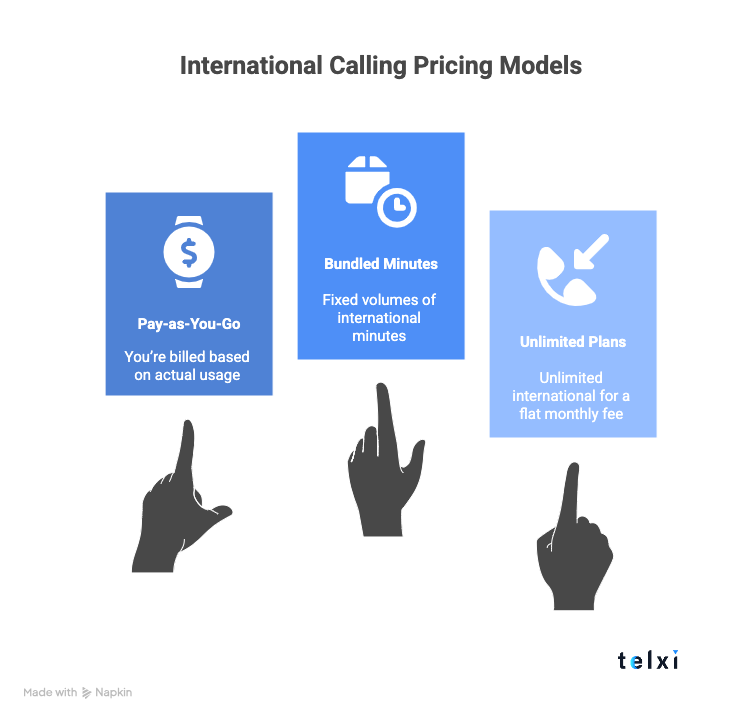
Once you move away from rigid legacy pricing, you gain access to flexible pricing models that make international calling more affordable and predictable. Here are the three most common models used by VoIP and SIP trunking providers:
international call rates models

1. Pay-as-You-Go (Per-Minute Pricing)

This model charges you based on actual usage, with rates varying by country, number type (landline vs mobile), and call destination. It’s the most flexible option if your international calling needs are inconsistent or still growing.

Best for: Early-stage teams, low-volume international callers, or businesses starting to test new markets.

2. Bundled Minute Packages

You pre-purchase a fixed number of minutes for certain countries or regions (e.g., 2,000 minutes/month to Europe). Bundles offer better per-minute rates and keep costs more predictable, with overages billed at standard rates.

Best for: Sales and support teams with consistent call patterns or businesses focusing on specific geographies.

3. Unlimited or Flat-Rate Plans

Flat-rate plans let you call certain countries without worrying about per-minute charges — ideal for high-volume operations. Just be aware of fair usage policies and limitations (e.g., mobile numbers may not be included).

Best for: Call centers, outbound sales, or global support teams with high and steady international traffic.

How Do You Know It’s Time to Migrate to SIP or VoIP?

By the beginning of 2027, BT, along with other big phone companies in the UK, will switch off PSTN and shift completely to digital services such as VoIP. So, for many businesses, the signs that it’s time to modernize are already there.

1. Your international call costs are rising unpredictably.
If your monthly bill varies wildly, that’s often a sign you’re on an outdated or rigid plan with high per-minute rates and hidden fees.

2. You’re expanding globally.
Whether you’re serving customers abroad or opening international offices, traditional systems make it hard (and expensive) to scale. SIP gives you instant global reach with local numbers and internet-based calling.

3. You need more flexibility for remote or hybrid teams.
Legacy phone systems are tied to physical locations. VoIP and SIP work anywhere your team has internet — enabling remote work, distributed teams, and centralized call management.

4. You’re paying for unused capacity.
With PRI, you often buy fixed blocks of channels — whether you use them or not. SIP lets you scale up or down instantly, so you only pay for what you actually need.

5. You’re struggling with vendor lock-in or poor support.
If you’re stuck in long-term contracts or can’t get clear billing or support from your current telco, that’s a red flag. SIP providers are often more transparent, flexible, and service-oriented.

How Telxi Helps You Reduce International Call Costs

We help businesses cut international call costs by replacing rigid PRI lines with scalable SIP trunking and enterprise-grade voice termination. Our network connects you to 190+ countries using high-quality, CLI-compliant routes — ensuring reliable call quality and regulatory compliance.

We offer transparent, country-specific rates with flexible pricing models (pay-as-you-go, bundles, or flat-rate). With instant local numbers in over 100 countries and expert migration support, we make it easy to modernize your phone infrastructure, reduce costs, and scale globally.

FAQ

  • It depends on the destination, the type of number (landline vs mobile), and your provider. Prices can range from under $0.01/min to over $1.00/min. SIP providers like Telxi offer transparent, country-specific pricing so you always know what you’re paying.

  • No — Skype for Business was officially retired by Microsoft in 2021 and replaced by Microsoft Teams. If your organization still uses it, it's time to migrate to a more modern, supported solution.

  • Calling the UK from a traditional phone carrier may cost between $0.05 to $0.30 per minute. With SIP or VoIP providers, you can expect rates below $0.02/min to landlines and slightly higher for mobile — depending on the route quality and provider.

  • Absolutely. Number porting lets you transfer your current business numbers to a new SIP or VoIP provider without losing them. It's a regulated process, and providers like Telxi support smooth, low-risk migrations