
This guide breaks down everything you need to know about business VoIP communications in 2026: What is it, how it works, how companies use it to scale, serve customers, and stay connected.
We’ll explore the three pillars of modern VoIP systems: SIP trunking, global phone numbers, and voice termination. You’ll also learn how to evaluate providers, the key benefits of cloud telephony, and why businesses around the world.
What Is VoIP (Voice over Internet Protocol)?
VoIP (Voice over Internet Protocol) is a technology that lets you make phone calls over the internet instead of using traditional landlines. It converts your voice into digital data and routes it through high-speed networks, making communication faster, cheaper, and more scalable for modern businesses.

Originally developed in the 1990s as a way to bypass expensive long-distance charges, VoIP has evolved into the backbone of cloud-based communications. Today, it powers everything from remote work tools and call centers to international business operations. With VoIP, companies can unify voice, video, and messaging across devices—while cutting costs and gaining global reach.
Main Questions About VoIP
- What is an example of VoIP?
An example is a cloud‑calling service where a business assigns desk phones and mobile “soft‑phones” via the internet, routes internal and external calls over its SIP trunk instead of legacy POTS lines, and uses virtual numbers to establish offices in different countries without physical infrastructure.
- What is the difference between VoIP and a phone call?
A traditional phone call uses the Public Switched Telephone Network (PSTN) — a circuit-switched system that routes calls over physical lines and infrastructure. In contrast, VoIP (Voice over Internet Protocol) transmits voice as data packets over the internet.
How Does VoIP Work?
VoIP transmits voice calls over the internet instead of traditional phone lines. When a user makes a call, their voice is converted into data packets, routed through the provider’s network, and delivered to the recipient via IP or the public telephone network (PSTN).
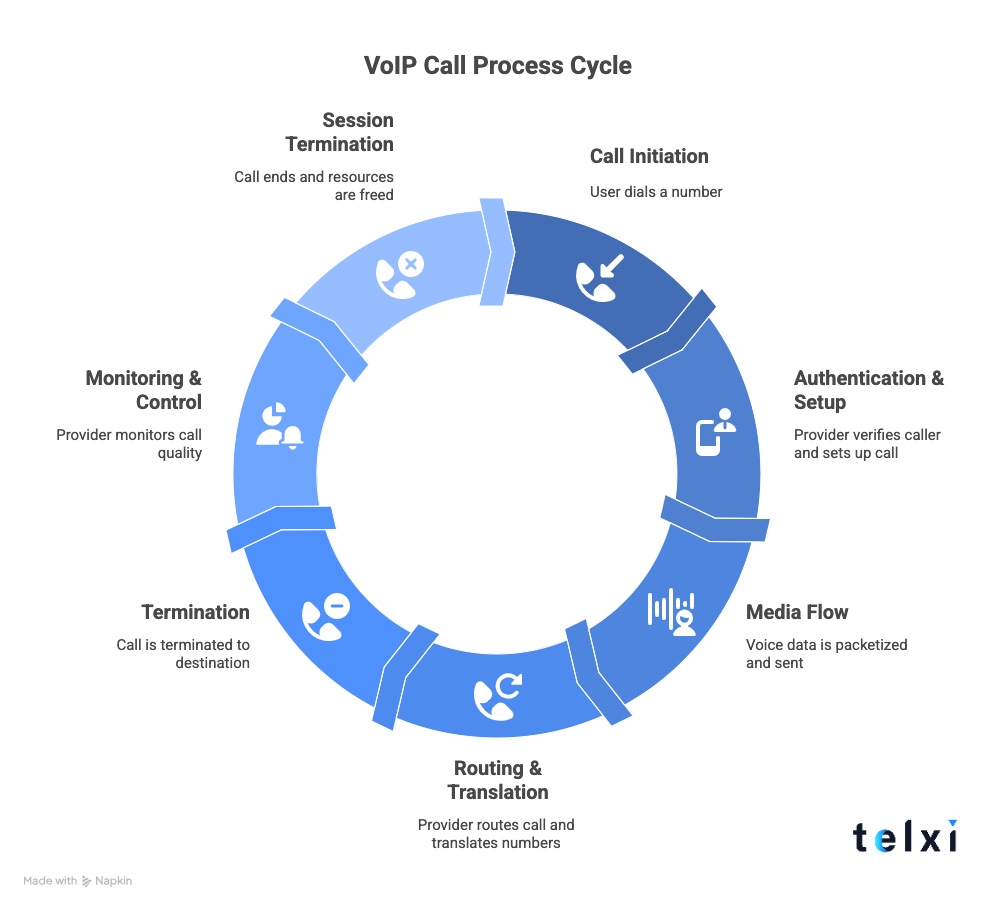
When a user places a call under a cloud VoIP set‑up, the voice is converted into data packets by the device (desk phone, soft‑phone, or mobile app). These packets travel over the internet to the service provider’s network, where an intelligent routing system (often using a combination of SIP trunking, global phone numbers, and voice termination) directs the call to its destination.
If the recipient is on another IP network, it stays digital. If the recipient is on a traditional landline or mobile, the system hands the call over to the Public Switched Telephone Network (PSTN) via voice termination gateways.
How VoIP Works: The Step-by-step Process
Call initiation: The user dials a number (via IP phone or app) — the device sends a Session Initiation Protocol (SIP) INVITE to the provider’s SIP endpoint.
Authentication & call setup: The VoIP provider’s SIP signalling verifies the caller, allocates a channel/trunk, and determines the destination route (either another IP endpoint or PSTN).
Media flow (voice packets): Once the call session is established, the voice data is packetised and sent over the internet—often over the provider’s private or high‑quality backbone network to reduce latency.
Routing & Number translation: If the destination is international or uses a local number, the provider maps the dialled number to the correct termination gateway or local presence resource (global number).
Termination: If the recipient is on a traditional landline/mobile, the packet stream is handed off into the PSTN via a voice termination gateway. If entirely IP‑based, it remains on the cloud network.
Call monitoring & quality control: The provider monitors metrics like jitter, packet‑loss and round‑trip delay; if issues emerge it may reroute or use alternate paths to maintain clarity.
Session termination: When the call ends (hang‑up from either party) a SIP BYE message is sent, the session closes, resources are freed, and billing/analytics data logged.
VoIP vs. Traditional Phone Systems
The main difference between VoIP and traditional phone systems is how calls are delivered. Traditional phones use physical landlines and on-premise hardware (like PBX systems), while VoIP calls are made over the internet using software-based infrastructure.
With VoIP, you can make and receive calls from anywhere with an internet connection, with no fixed wiring or location required. This shift enables greater flexibility, lower costs, easier scalability, and more advanced features compared to legacy systems.
The table below presents a clear comparison across key factors, focusing on how a true Voice over Internet Protocol (VoIP) model differs from traditional systems.
| Feature | Traditional Phone Systems | VoIP (Cloud‑Based Business Calling) |
|---|---|---|
| Technology & Infrastructure | Uses dedicated copper lines or circuit‑switched networks (PSTN/ISDN) | Uses packet‑switched networks over the Internet — voice converted to data packets |
| CAPEX (Upfront Costs) | High — physical PBX, wiring, dedicated hardware, site infrastructure | Low — minimal on‑site hardware, infrastructure is virtualised or provider‑managed |
| Scalability | Limited — scaling means installing new lines/hardware, rewiring, and often long lead times | Instant and flexible — add users, channels, countries via software and cloud provisioning |
| Maintenance & Management | On‑site maintenance, physical equipment servicing, and hardware replacements | Centralised management, updates, and monitoring delivered by the provider, less on‑site burden |
| Call Quality & Features | Consistent (because it’s a dedicated circuit) but limited in advanced features; tied to physical infrastructure | High potential (HD voice, global routing, local presence numbers), with features like apps, soft‑phones, unified communications |
| Global Readiness & Flexibility | Tied to a specific location, local telco contracts, physical presence required—less suited for global/distributed teams | Excellent — virtual numbers across regions, remote/ hybrid teams supported, infrastructure built for global scale |
| Reliability in Outages / Failover | Generally reliable in local infrastructure, but tied to physical site; moving location or adding offices is harder | Dependent on internet quality, but modern VoIP can offer built‑in redundancy, auto‑failover, and a distributed architecture |
Key Components of VoIP
Cloud-based VoIP is an ecosystem of integrated components that together enable seamless, global communication. At the core of this system are SIP Trunking, Global Phone Numbers, and Voice Termination.
SIP Trunking: The Backbone of Scalable Calling
A SIP trunk is a virtual phone line delivered over the Internet. It connects your cloud or IP phone system to the public telephone network, allowing you to make and receive calls globally — without needing physical infrastructure. A SIP trunking provider enables flexible capacity, fast provisioning, and a far lower cost than legacy phone lines. It’s how modern businesses scale their communications as they grow.
Related: SIP Trunking: The Ultimate Guide for Businesses in 2026
Global Phone Numbers: How Businesses Establish Local Presence Worldwide
Global phone numbers let businesses create a local identity in international markets, without opening physical offices. By renting local numbers in cities or countries around the world, companies can route customer calls to their teams anywhere. This builds trust, improves customer experience, and supports global growth with minimal overhead.
Voice Termination: Ensuring Global Call Quality and Routing Efficiency
Voice termination is the final stage in a VoIP call, when your provider hands off the call to the recipient’s carrier, whether it’s a mobile, landline or VoIP network. The quality of this step determines how clearly and reliably your call is delivered. High-quality termination uses intelligent routing, multiple global carriers, and constant monitoring to ensure calls are crisp, fast, and cost-efficient.
5 Benefits of VoIP for Businesses
Adopting a cloud‑based VoIP communication system transforms how businesses operate. Here are the major advantages your business can leverage:
- Cost Reduction: Cloud VoIP systems eliminate the need for expensive physical hardware, dedicated phone lines, or on‑site PBX equipment. This means lower upfront investment, fewer maintenance costs and more predictable monthly charges.
- Scalability & Flexibility: As your business grows or shifts, cloud‑based VoIP allows you to add or remove users, lines, or features quickly — without waiting on new wired installations. It supports distributed teams, hybrid work models and agile expansion.
- International Reach & Local Presence: With cloud VoIP, you can deploy global phone numbers, route calls internationally, and maintain local presence in target markets — all without physical offices in every location. This supports global business operations with ease.
- Reliability & Future‑Proof Infrastructure: Cloud‑hosted systems are built for redundancy, high availability and remote access. They reduce dependence on single locales or hardware failures, making them more resilient and better suited for future communication demands.
- Regulatory Compliance & Security: Modern cloud VoIP systems offer advanced security protocols (e.g., encryption, endpoint protection), centralized policy management and infrastructure that supports compliance with industry regulations — crucial for businesses handling sensitive communications.
Disadvantages and Risks
- What is a disadvantage of using VoIP?
One of the main drawbacks is that VoIP depends on a stable internet connection — if bandwidth is poor, latency is high or the connection drops, call quality suffers or the service may not work at all.
- What are the risks of VoIP?
Risks include:
Security vulnerabilities (eavesdropping, spoofing, denial‑of‑service) because the service runs over the internet.
Call quality issues if infrastructure (Internet connection, network configuration) is inadequate.
Reliance on power/internet means in outages your voice service may fail unless backup arrangements exist
How Much Does VoIP Cost?
Understanding the cost of a business‑grade VoIP system is crucial for budgeting and choosing the right provider. In this section we’ll break down the common cost components and outline how to estimate your total cost for a cloud VoIP deployment.
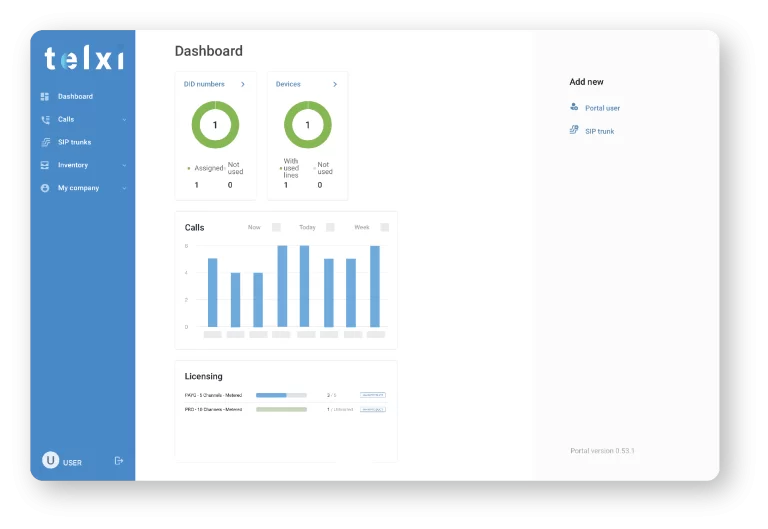
Typical VoIP Cost Components
Here are the main cost elements you’ll see when evaluating a VoIP solution:
Monthly numbers (DIDs): The fee charged per local (or international) phone number your business uses.
Per‑minute call charges: For outbound or inbound calls, especially when using pay‑as‑you‑go voice termination or global minutes.
Trunk/channel fees: Some providers charge a fixed fee per concurrent call or per “channel” you enable.
Setup/porting fees: One‑off costs such as number porting, initial configuration or equipment.
Hardware/endpoint equipment: If you’re using IP phones or on‑premises gateways (though cloud‑first models tend to minimise this).
Add‑ons & features: Voicemail, call‑recording, analytics, international rates, faxing—these may all add recurring or usage‑based charges.
Hidden/overage charges: Be alert for peak usage, termination in certain regions, or special routing fees which may raise the total cost.
Estimating Your Total Cost
To estimate what your business might spend, use this simple formula:
Total Cost ≈ (Number of DIDs × monthly DID cost) + (Monthly minutes × per‑minute rate) + Fixed tray/trunk fees + One‑time setup costs
Here are a few scenarios:
Small team (10 employees, 5 DIDs, 500 minutes outbound/month)
Using a DID cost of US$1, per‑minute rate US$0.01:
‑ Monthly DID cost = 5 × US$1 = US$5
‑ Call cost = 500 × US$0.01 = US$5
‑ Total monthly ≈ US$10 (plus any fixed channel fees)
‑ One‑time porting/setup maybe US$5 or similarGlobal expansion (100 DIDs in various countries, 10,000 minutes/month)
DID cost = 100 × US$1 = US$100
Call cost = 10,000 × US$0.01 = US$100
Plus extra for international termination (which may cost more than US$0.01/min), higher trunk/channel fees, regional compliance or premium SLAs.Call‑centre/high‑volume case (unlimited minutes plan or high usage)
Some providers offer “unlimited” or high‑volume plans instead of per‑minute. In such cases you’ll focus more on channel concurrency, fixed trunk fees and compliance/quality‑assurance costs rather than minute‑by‑minute charges.
Who Uses VoIP?
Businesses of many types rely on cloud‑based communications. For example: contact centres handling global customer service, remote and hybrid teams collaborating across time zones, SaaS and e‑commerce companies supporting clients 24/7, and large enterprises managing multi‑country operations. Below we explore these core use cases in detail.
Contact Centres Scaling Globally
Contact centres — whether handling customer support, sales, or help‑desks — benefit massively from cloud VoIP systems. With virtual channels, local inbound numbers and flexible routing, they can efficiently manage call volumes and geographic distribution. Providers with robust global voice termination offer reliable performance and high availability, which are critical in this scenario.
Remote & Hybrid Teams
With teams working from home, in office hubs or travelling globally, cloud VoIP enables seamless voice (and sometimes video) calling from any internet location. Employees log into the system via soft‑phones or mobile apps and maintain professional calling presence. As one source noted, VoIP keeps remote workers connected and productive.
SaaS and E‑commerce Support Systems
SaaS platforms and e‑commerce businesses often require rapid‑response voice support, global customer reach, and integration with digital workflows (CRM, chat, analytics). VoIP systems allow them to spin up local numbers in target markets, route inbound calls intelligently, and tie voice channels into their digital ecosystem.
Enterprises Managing Multi‑Country Presence
Large enterprises with operations in multiple countries need communication infrastructure that supports global reach, local presence and unified management. Cloud VoIP systems allow them to deploy local numbers in different countries, terminate calls globally, and manage everything from a central platform — without maintaining separate legacy PBXs in each region.
Best VoIP Providers
Here are five leading VoIP providers and what sets each apart in the cloud communications landscape:
- Telxi — Built for global businesses with carrier-grade infrastructure, crystal-clear voice, and unified access to SIP, global numbers, and termination—all under one platform.
- RingCentral — Offers a comprehensive UCaaS solution with voice, video, and messaging in one interface. Ideal for businesses needing robust collaboration tools.
- 8×8 — Known for international VoIP coverage, analytics, and integrations with CRM tools. Suitable for businesses expanding across borders.
- Zoom Phone — Expands the popular Zoom platform with voice capabilities. Great for teams already embedded in Zoom’s ecosystem.
- Nextiva — Easy-to-use, affordable VoIP system for small and midsize businesses. Offers strong customer support and quick onboarding.
How to Choose the Right VoIP Provider
Selecting the right VoIP provider is critical; it can mean the difference between seamless global communications and ongoing frustration. Focus on five core areas: uptime & call quality, security & compliance, global coverage, support & provisioning speed, and transparent pricing. Each helps ensure you pick a partner that aligns with your business needs and growth ambitions.
Uptime & Call Quality
Reliable service with minimal downtime and consistent call clarity should be non‑negotiable. When evaluating a provider, look for:
Service‑level agreements (SLAs) guaranteeing high uptime (e.g., 99.99 %) and redundant infrastructure.
Evidence of managed network quality: low latency, minimal jitter/packet‑loss, and prioritisation for voice traffic.
Robust routing and infrastructure detailing how calls are handled during peak load or failure scenarios.
Security & Compliance (TLS, SRTP)
VoIP is as much about secure data transport as it is about connectivity. Key considerations:
Does the provider support strong encryption for signalling (e.g., TLS) and media streams (e.g., SRTP)?
Are they compliant with relevant regulations (e.g., GDPR, HIPAA, PCI‑DSS) depending on your industry or geography?
What are their policies for data retention, access control, incident response, and network hardening?
Choosing a provider with rigorous security credentials helps protect voice traffic, which increasingly carries sensitive business communication.
Global Coverage
A provider should support your international presence and future expansion. Look for:
A large number of local geo‑numbers in key markets you operate in or plan to enter.
Voice termination capability in many countries, with direct routing.
Robust global infrastructure to maintain call quality across regions and time zones.
Global reach means you can present a local presence to customers, serve teams remotely, and scale internationally with fewer barriers.
Support & Provisioning Speed
The best VoIP system is only as good as how quickly it can be deployed and how well it’s supported:
How fast can new numbers, trunking channels, or users be provisioned?
What support channels are available (24/7 phone, chat, email)? What is the average response time?
Does the provider offer onboarding help, migration support, documentation, and training to make adoption smooth?
Rapid provisioning + strong support = less downtime, faster ROI, and better user experience.
Transparent Pricing
When choosing a provider, ensure clarity around:
Price model (per user, per minute, flat rate) and what is included versus what is an add‑on.
Hidden fees (setup, number porting, international minutes, cancellation).
Scalability of pricing: Can you add/remove services easily without lock‑in or heavy penalties?
Transparent and predictable pricing gives you confidence to budget and scale without fear of cost escalation.
Why Businesses Choose Telxi

When companies require voice communications that scale globally, adapt quickly, and deliver carrier‑grade quality, they turn to Telxi. Here’s what sets Telxi apart:
1. Global SIP Backbone + Carrier‑Grade Reliability
Telxi’s platform is built on a resilient, private multi‑cloud network with multiple Points of Presence (PoPs) around the world — meaning calls are routed via high‑quality paths, not generic internet links.
This ensures:
-
Low latency, minimal jitter, and packet loss for voice traffic
-
High availability with redundant routing and fail‑over infrastructure
-
Clear voice quality across international distances
For businesses operating globally, this infrastructure backbone gives confidence that their voice communications won’t bottleneck or degrade as they scale.
2. “Global Reach + Local Presence”
Telxi enables companies to establish local phone numbers (DIDs) in 100+ countries, route calls from anywhere in the world, and manage everything centrally.
What this means for a business:
-
Appear local in target markets without physical offices
-
Receive inbound calls from customers with local‑looking numbers, improving trust and conversion
-
Call out globally with local or international termination paths built into one platform
This dual capability—global footprint + local identity—is increasingly important for SaaS, e‑commerce, contact centers, and enterprises with distributed teams.
3. Smooth Integration + Transparent Pricing
Beyond raw infrastructure, Telxi is designed for modern business workflows:
-
API‑friendly: Easily integrate with PBX systems, soft‑phones, UCaaS platforms, or custom voice stacks.
-
Pay‑as‑you‑go and transparent: No hidden minimums or hard‑to‑predict fees—so businesses can scale without billing surprises.
For organisations that need agility (rapid deployment, dynamic user counts, international expansion), this delivers both technical freedom and cost flexibility.
4. Designed for Business‑Critical Voice
Telxi doesn’t treat voice as a side service—it treats it as the backbone of your communications. Features include:
-
Fully encrypted signalling and media (TLS & SRTP) for secure calls.
-
Real‑time analytics, call recording, fraud‑prevention, and regulatory support across regions.
-
Support teams available 24/7 and SLA‑driven reliability so you’re not dealing with basic consumer‑grade support.
In short, when your voice channel is part of your brand promise, Telxi provides the infrastructure and features to treat it as mission‑critical.
FAQs About VoIP
- Why would someone use a VoIP number?
A VoIP number lets you make and receive calls over the internet instead of relying solely on traditional landlines or mobile‑networks. You gain flexibility (call from anywhere with an internet connection), scalability (add users or numbers quickly), and cost‑efficiency (lower infrastructure and call costs).
- Why is everyone switching to a VoIP phone?
Businesses and organisations are switching because VoIP offers lower upfront and operating costs, easier scalability, global reach (remote work, multiple countries), unified communication features, and faster deployment compared with legacy PBX systems
- Can VoIP calls be traced?
Yes, VoIP calls can be traced, but the process may be more complex than traditional phone calls. You or your service provider can examine call‑logs, IP addresses, and routing domains. Cooperation from carriers may be required.
- What happens to VoIP when the internet is down?
If your internet connection goes down, your VoIP service typically cannot make or receive calls, unless you have specially configured backup routing (such as auto‑failover to mobile data or alternate ISP).


