
In this guide, we’ll break down exactly what voice termination is, how it works in VoIP and SIP environments, and why it matters for call quality, reliability, and cost. You’ll learn the differences between retail and wholesale termination, what affects global call performance, and how to choose the right provider for your needs.

What Is Voice Termination?

Voice termination, or VoIP Termination, refers to the process of delivering an outbound phone call from the caller to the final recipient. In simpler terms, it’s what happens when a call leaves your VoIP or PBX system and travels through various carriers until it rings on someone else’s phone.

Voice Termination: Full Guide For Businesses 2026 1 - Telxi

In a typical VoIP setup, when you make a call, your provider sends it through a series of interconnected carriers until it lands on the recipient’s phone. This routing is what we call voice termination, and it’s a critical part of any outbound communication.

Example:
Imagine a support agent in São Paulo calling a customer in Paris. The call travels from the agent’s VoIP app to a SIP trunk, then hops through a mix of local and international carriers, and finally connects to the customer’s mobile number in France. That entire journey is voice termination.

Voice Termination Main Questions

  • VoIP stands for Voice over Internet Protocol—a technology that allows you to make voice calls using the internet instead of traditional phone lines

  • VoIP offers lower costs, greater flexibility, and global reach compared to traditional telephony. It’s ideal for remote teams, international businesses, and modern communication systems.

  • Call termination is the technical term for routing an outgoing call from its origin to its final destination. It’s the last leg of the call’s journey—and what makes the ring happen on the other end.

How Voice Termination Works (Step-by-Step)

Voice termination is the process of delivering outbound calls from your business phone system to your customer’s phone anywhere in the world. In a VoIP environment, this involves routing your calls through SIP trunks and carrier networks, and finally to the recipient’s landline, mobile, or VoIP service.
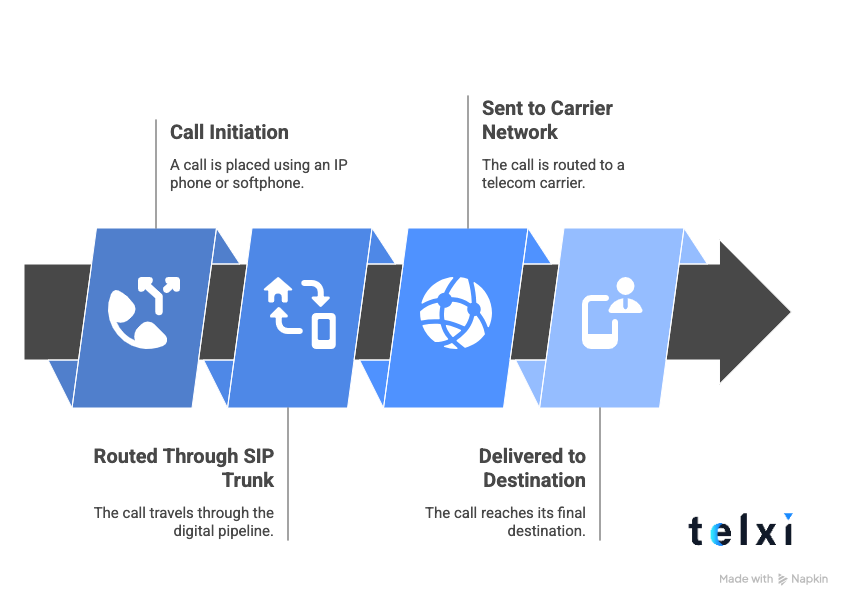
voice termination process

Here’s how it works:

Step-by-Step Breakdown

1. Call Is Initiated
The process begins when someone at your business places a call via a physical IP phone, a desktop softphone, or a UCaaS platform such as Microsoft Teams or Zoom Phone. That call is first handled by your internal PBX (private branch exchange) or VoIP system.

2. Routed Through SIP Trunk
Once the call leaves your PBX, it travels over your SIP trunk. This is the digital pipeline that connects your internal phone system to the wider VoIP network. The SIP trunk packages the voice data and prepares it for delivery across the Internet or private IP networks.

3. Sent to a Carrier Network
Your SIP provider (like Telxi) then routes the call to a telecom carrier. The choice of carrier—and the path the call takes—depends on the destination country, call quality requirements, and cost. This is where decisions like premium vs standard routing come into play.

4. Delivered to Destination
Finally, the carrier delivers the call to its final destination. This could be a traditional landline, a mobile number, or another VoIP endpoint. The call is “terminated” successfully once the recipient picks up and audio is transmitted both ways.

VoIP Termination vs. VoIP Origination: What’s the Difference?

VoIP termination and VoIP origination refer to opposite ends of a phone call.

  • VoIP termination is the delivery of outbound calls from your business to the recipient. It’s about sending the call.

  • VoIP origination is the process of receiving inbound calls from the public phone network into your VoIP system. It’s about receiving the call.

Both are essential for complete two-way communication in any VoIP environment.

FeatureVoIP TerminationVoIP Origination
DirectionOutbound (you call others)Inbound (others call you)
FunctionDelivers your calls to external phonesReceives calls from external networks
Primary Use CaseSales, support, outbound operationsCustomer service, inbound hotlines
InvolvesSIP trunk → carrier → destinationDID number → VoIP platform
Provider TypesSIP providers, wholesale carriersVoIP providers, DID services
Cost FactorsPer-minute rates by destinationMonthly fee per DID + inbound minutes

Types of Voice Termination Services

Voice termination varies depending on the levels of scale, control, and cost-efficiency. Here are the 7 types of VoIP Termination services:

Retail Termination

Designed for businesses that need reliable, high-quality outbound calling without handling carrier-level routing. This is ideal for SMBs, call centers, and enterprises using VoIP systems or UCaaS platforms. You get a user-friendly interface, stable rates, and integrated features like number masking, analytics, or call recording.

Wholesale VoIP Termination

This type is built for other service providers: VoIP resellers, ITSPs (Internet Telephony Service Providers), and telecom aggregators. It supports large call volumes at discounted A-Z rates, often with direct carrier interconnects and traffic-based billing. Wholesale models typically require SIP trunking and technical expertise.

A-Z Termination

A-Z (short for “Afghanistan to Zimbabwe”) is a wholesale offering that includes outbound call coverage to every country and territory. Providers maintain rate decks for each destination and route quality can vary depending on pricing (premium vs. standard). It’s often used by call centers, international businesses, or resellers managing global traffic.

SIP Termination

This refers specifically to using the SIP protocol to route outbound VoIP calls. SIP termination providers act as a bridge between your internal VoIP system and the PSTN (Public Switched Telephone Network), enabling outbound calls to landlines, mobile phones, or international numbers. Most modern VoIP systems rely on SIP-based call handling.

On-Net Termination

With on-net termination, both the caller and recipient are on the same network or platform. Since the call doesn’t pass through the PSTN or other carriers, it’s cheaper, faster, and more secure. Internal company calls or users on the same UCaaS platform (like Telxi-to-Telxi) are great examples.

Off-Net Termination

Off-net termination happens when the call exits your provider’s network, such as calling a mobile number or landline on a different service. These calls go through external carriers and may involve higher costs or more complex routing logic.

International Termination

For outbound calls that cross national borders, international termination ensures your voice reaches global destinations with low latency and high clarity. Providers offering international termination work with Tier 1 and regional carriers to maintain consistent quality and regulatory compliance across countries.

TypeBest ForDescriptionCost LevelGlobal Coverage
Retail TerminationSMBs, Enterprises, Call CentersStandard VoIP termination with full features and easy setupModerateYes
Wholesale VoIP TerminationVoIP Providers, AggregatorsHigh-volume traffic at discounted A-Z ratesLow (volume-based)Yes
A-Z TerminationGlobal Call Centers, ResellersOutbound coverage for all global destinationsVaries (per route)Yes
SIP TerminationAny VoIP SystemOutbound routing using SIP protocolLow to ModerateYes
On-Net TerminationInternal Calls, Same Platform UsersCalls stay within the same provider’s networkLowLimited
Off-Net TerminationExternal Calls, Mixed NetworksRoutes calls to external carriers or PSTNModerate to HighYes
International TerminationGlobal BusinessesRoutes outbound calls to international destinationsVaries by regionYes

4 Benefits of Using Voice Termination

Here’s why choosing the right termination partner matters for your business:

Voice Termination: Full Guide For Businesses 2026 4 - Telxi

1. Enhanced Reliability

High-quality termination providers use direct interconnects with Tier 1 carriers and global route optimization to reduce jitter, latency, and dropped calls. This results in crystal-clear voice quality, even on international calls.

When your sales or support team speaks to customers, they hear every word. That means fewer misunderstandings, better service, and more closed deals.

2. Cost Efficiency at Scale

With intelligent least-cost routing (LCR), VoIP termination services can find the most economical path for each call without sacrificing quality. Wholesale pricing tiers make high-volume calling significantly cheaper.

Whether you’re running a global contact center or scaling outbound sales, you’ll save thousands monthly compared to traditional telco pricing.

3. Regulatory Compliance

Good termination providers comply with international telecom regulations, including lawful intercept, emergency routing, and number formatting standards. They also understand local policies in restricted markets.

Stay out of legal hot water and avoid service disruptions, especially when operating across borders.

4. Brand Trust & Professionalism

Consistently clear outbound calls build brand credibility, especially with cold calls, client follow-ups, or critical support calls. Call masking, CLI management, and number registration also help ensure proper display on recipient devices.

Who Needs Voice Termination Services?

Voice termination is essential for any business that places outbound calls at scale or across borders. But certain industries depend on it more than others, where call quality, reliability, and cost directly impact revenue and reputation.

BPOs & Call Centers

Whether it’s customer support, collections, or outbound sales, call centers place thousands of calls per day. Any drop in audio quality, latency, or failed connections means lost revenue and frustrated clients.

High-quality voice termination ensures every agent’s call connects clearly regardless of the customer’s location. With features like call masking BPOs can also localize their outreach to improve answer rates.

Partnered Services & Enterprises

Enterprises that offer services over the phone (finance, healthcare, legal, logistics) rely on voice calls to deliver value. This includes appointment confirmations, transaction alerts, client updates, and internal operations.

These organizations need crystal-clear, dependable voice routes with regulatory compliance baked in.

Embedded Communications in Apps & Services

SaaS platforms, delivery apps, marketplaces, and communications APIs often include voice as a feature. For instance, think “click-to-call” buttons, automated support lines, or user-to-user calling.

Embedded voice needs to work instantly and globally. High-quality termination ensures in-app calls are fast, clear, and scalable without straining engineering teams.

Key Factors That Affect Voice Quality

Below are the 4 most common factors that affect voice quality.

1. Latency

Latency is the time it takes for a voice packet to travel from your speaker’s mouth through your system, across the network, and finally to the listener’s ear. It is the delay. In VoIP, excessive latency (e.g., >150 ms one‑way) shows up as awkward pauses, overlaps, or lag.

Longer or multiple hops raise latency and can degrade your routing quality. A termination provider with fewer hops costs more but safeguards latency.

2. Jitter

Jitter is the variation in the delay of data packets traveling over a network, causing them to arrive at inconsistent times. This is different from latency, which is the total delay, as jitter measures how much that delay fluctuates.

Jitter‑induced audio issues erode professionalism and may force agents to repeat themselves many times or clarify. Good termination services monitor jitter across their network and avoid “cheap” indirect routes prone to variation.

3. Packet Loss

This is when packets never arrive. Because most voice traffic uses UDP (which doesn’t retransmit by default), lost packets equal missing audio. This issue can lead to a possible lost sale or disgruntled support caller.

Routes with heavy packet loss often come from low‑cost but quality‑compromised carriers. Paying slightly more for better termination can save frustration and time.

4. Codec Choice

Codecs compress and transmit your voice. Some prioritize bandwidth; others prioritize quality. For example, a wideband codec (e.g., G.722) delivers more natural audio but uses more bandwidth than a narrowband one (e.g., G.729).

Using a low‑quality codec might cut costs, but your callers may perceive you as cheap or unprofessional. The best providers balance codec choice so you get clear audio without overpaying for excessive bandwidth.

Summary Table

FactorWhat it AffectsBusiness ImpactCost/Quality Trade‑Off
LatencyCall delayPoor flow, interruptions in conversationBetter routes cost more, but save time & trust
JitterVariability of packet arrivalChoppy audio, repeats, frustrationNetworks with strong QoS incur higher cost
Packet LossMissing voice data packetsParts of the message go unheardCheap routes often skip quality checks
Codec ChoiceVoice clarity vs bandwidth usePoor sound = poor brand impressionHigher‑quality codec may use more bandwidth

How to Choose the Right Voice Termination Provider

Choosing a voice termination provider isn’t just about finding the cheapest outbound calling rate. It’s about ensuring every call—especially mission-critical ones—connects clearly, quickly, and consistently. Here’s how to evaluate the right provider for your business:

Global Coverage

If your business serves customers in multiple regions, your termination provider must offer truly global reach. That means not just having routes to major countries—but having quality routes with Tier 1 or direct partners.

What to look for:

  • A-Z (all destinations) coverage with real availability, not just listed.

  • Strong routing in key regions: North America, LATAM, Europe, APAC, MENA.

  • Regional failover: can the provider reroute calls instantly if a carrier fails?

Transparent Pricing

One of the most common complaints among VoIP termination users is hidden fees.: surprise surcharges, minimum commitments, or hidden connection fees kick in. True transparency means you know exactly what you’ll pay for every call, before placing it.

What to look for:

  • Per-minute rate sheets available by country and carrier tier.

  • No hidden charges (e.g., setup, connection, failover penalties).

  • Predictable billing models: pay-as-you-go, volume discounts, flat rate.

Uptime & Redundancy

Most provider claims “99.99% uptime”, but in real life that doesn’t happen, so ask how they back up those numbers and what infrastructure supports that reliability.

What to look for:

  • Redundant routes across multiple data centers and carriers.

  • Real-time failover: automatic rerouting on call failure.

  • Public or contractual SLA (Service Level Agreement).

Support & Monitoring Tools

When it comes to voice termination, support is critical. You need fast, knowledgeable support ready to step in. But equally important is having the visibility to understand what’s happening before issues escalate. The best providers give you real-time monitoring tools, call analytics, and performance dashboards so you’re not flying blind.

What to look for:

  • 24/7 live technical support with fast escalation paths.

  • Real-time dashboards showing call quality, volume, route success.

  • Instant alerts for call degradation, routing failures, or billing spikes.

Why Businesses Choose Telxi

Telxi is the go-to provider for high-quality and reliable voice termination services. They offer a global reach and flexible solutions to meet all your communication needs. Many companies, such as Bolt and Eurogate, choose Telxi because they can connect to a crystal-clear international and local voice network.

Voice Termination: Full Guide For Businesses 2026 6 - Telxi

Global Interconnects with Tier‑1 Carriers

Telxi partners with top-tier global carriers to ensure your outbound calls are delivered through the most direct and reliable routes available. This means fewer hops, lower latency, and crystal-clear voice quality for every call, no matter where it lands.

Real‑Time Monitoring and Redundancy

With built-in redundancy and continuous real-time monitoring, Telxi guarantees uptime and resiliency. If a route goes down or degrades in quality, traffic is rerouted automatically, ensuring uninterrupted service without manual intervention.

Transparent Pricing Model

Unlike many wholesale providers, Telxi believes in absolute pricing transparency. No sneaky surcharges, minimum commitments, or fuzzy rate sheets, just clear per-minute pricing across every destination, so you can forecast costs with confidence.

24/7 Support

When it comes to outbound calling infrastructure, delays and downtime aren’t an option. Telxi offers 24/7 support staffed by real experts, so you can get issues resolved fast, whether it’s provisioning help, route debugging, or failover management.

FAQs About Voice Termination

  • "Voice" refers to traditional phone services over copper lines or mobile networks. VoIP (Voice over Internet Protocol) transmits voice data digitally over the internet. While the end experience is similar (you hear someone's voice), the underlying infrastructure is completely different.

  • They're closely related. "Digital voice" is a broad term for any voice transmitted in digital form, and VoIP is a specific type of digital voice service that uses internet protocols. In practice, many providers use the terms interchangeably.

  • Yes, Google Voice is a VoIP service. It lets users make and receive calls over the internet instead of traditional phone lines. However, it's a consumer-grade platform and lacks the routing control, scalability, and quality guarantees required for business-grade voice termination.

  • No. While it’s primarily used for voice, VoIP can also support video calls, text messaging, faxing, and other real-time communication features—depending on the platform and integration.

  • A voice termination route is the path your outbound call takes through various carrier networks until it reaches the recipient. Quality and pricing vary depending on how direct or indirect this route is.